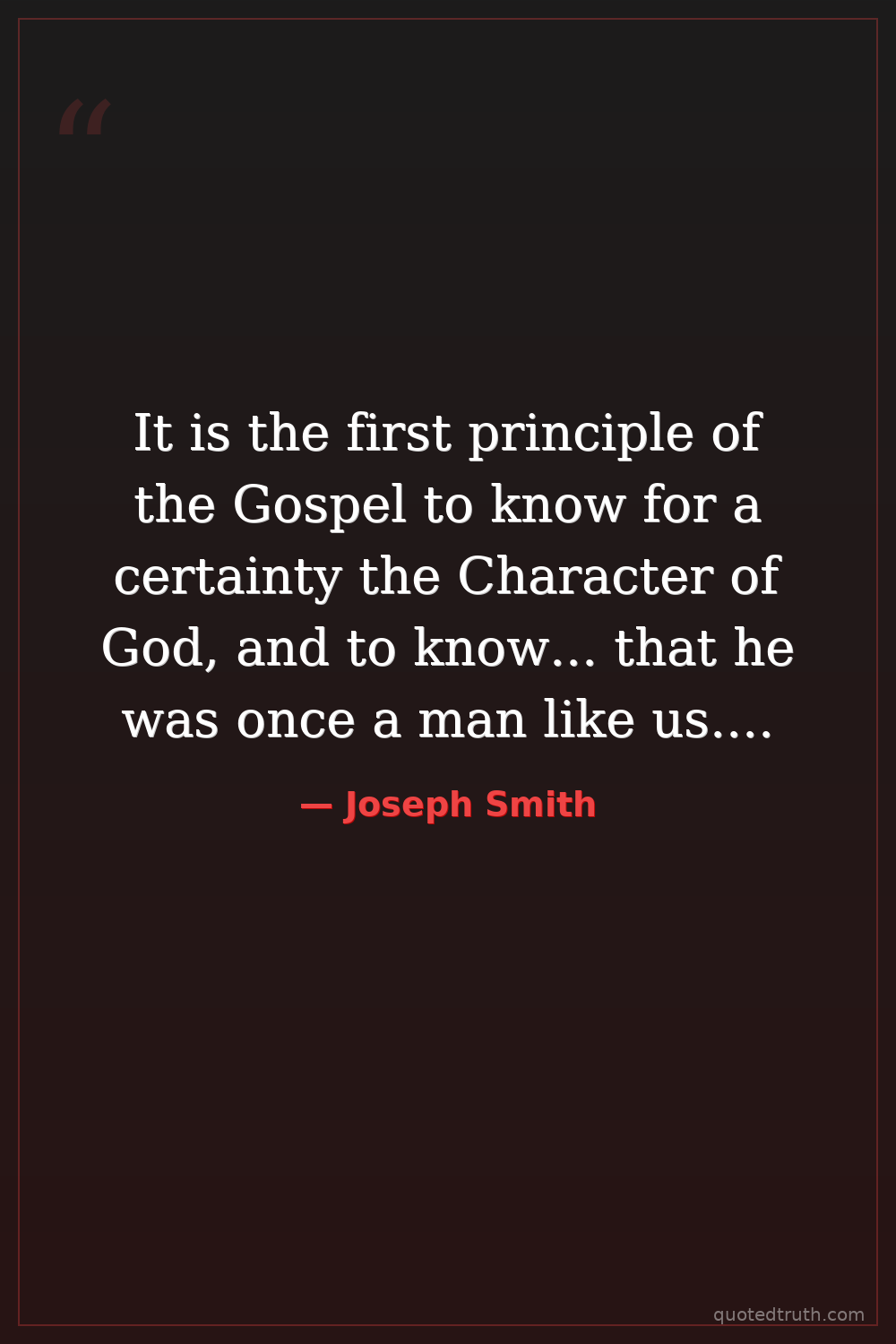
Joseph Smith — "It is the first principle of the Gospel to know for a certainty the Character of…"
It is the first principle of the Gospel to know for a certainty the Character of God, and to know... that he was once a man like us....
It is the first principle of the Gospel to know for a certainty the Character of God, and to know... that he was once a man like us....
Click any product to generate a realistic preview. Up to 3 at a time.
* Initial load can take up to 90 seconds — revising the preview in another color is nearly instant.
"I combat the errors of ages; I meet the violence of mobs; I cope with illegal proceedings from executive authority; I cut the Gordian knot of powers, and I solve mathematical problems of universities,…"
"I am not a sectarian, but a lover of truth."
"I will prophesy that the Saints will continue to suffer much affliction, and will be driven to and fro, from the east to the west, and from the north to the south, until they are purified."
"I am a man of godliness, and I will be godly in all things."
"For behold, the Lord shall curse the land with much heat, and the barrenness thereof shall go forth forever; and there was a blackness came upon all the children of Canaan, that they were despised amo…"
Found in 1 providers: gemini
1 source checked
Knowing God's true nature is the foundation of all religious life — and God was once a mortal human being who progressed to divinity. This challenges the traditional Christian idea of God as eternally perfect and wholly separate from humanity. The divine and human are not separated by an unbridgeable gap: humans can become what God is, because God once was what humans are.
Joseph Smith founded the Latter-day Saint movement through claimed continuous revelation, radically departing from Protestant orthodoxy. This comes from his King Follett discourse, delivered April 1844 in Nauvoo, Illinois, just weeks before his death by mob violence. It crystallizes his doctrine of eternal progression — that God once lived as a mortal and humans can achieve godhood — the most theologically daring claim of his prophetic career.
The 1840s were a period of intense religious experimentation in America — the Second Great Awakening had generated dozens of new sects and self-proclaimed prophets. Smith delivered this sermon when Mormonism was rapidly expanding yet facing violent persecution. His claim that God was once human directly confronted mainstream Protestant theology, inflaming existing tensions that would lead to his arrest and murder by a mob just months later.
AI-generated insights based on extensive research and information for context. Factual errors? Email [email protected].
Your cart is empty