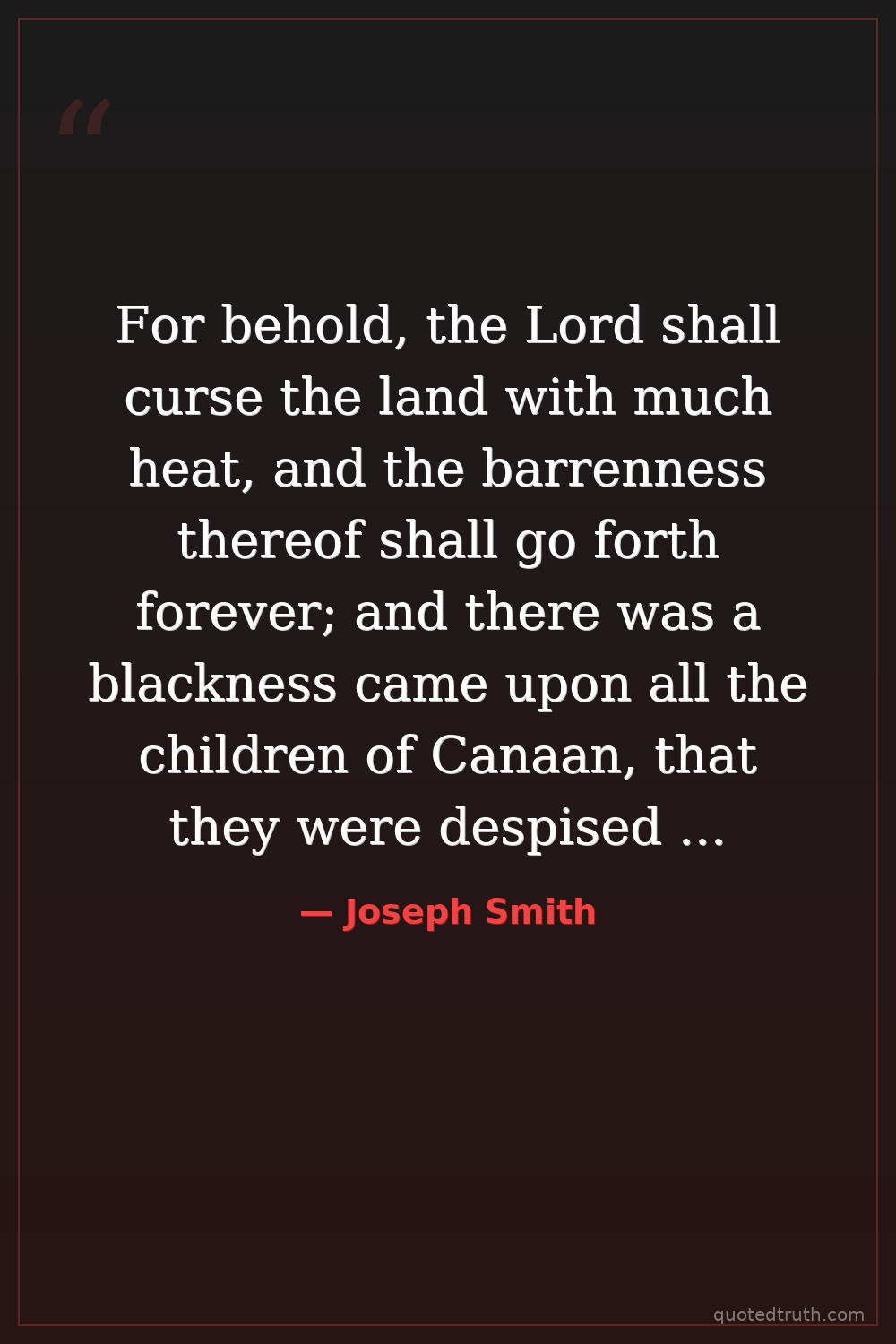
What it means
A divine curse is declared over a land, making it perpetually barren and scorched. Separately, a physical darkening is described as falling upon Canaan's descendants, marking them as socially outcast. The passage frames environmental destruction and racial othering as acts of divine will, presenting inherited divine punishment as both physical and agricultural, affecting land and people across generations.
Relevance to Joseph Smith
Joseph Smith produced this text as part of the Book of Abraham (1835–42), claiming divine translation of Egyptian papyri. As LDS founder and self-declared prophet, his writings carried doctrinal authority. This passage directly shaped the LDS Church's priesthood ban on Black members—a policy rooted partly in this curse-of-Canaan framework—which remained official doctrine until Spencer W. Kimball's 1978 reversal.
The era
Smith produced this text in the 1830s–40s, when the 'curse of Ham/Canaan' was the dominant theological argument used across American denominations to rationalize slavery and racial hierarchy. Abolitionist and pro-slavery factions both cited scripture. The Book of Abraham entered this charged debate, and its racial passages influenced LDS policy for over a century, making it historically significant within American religion and race history.
AI-generated insights based on extensive research and information for context. Factual errors? Email [email protected].