What it means
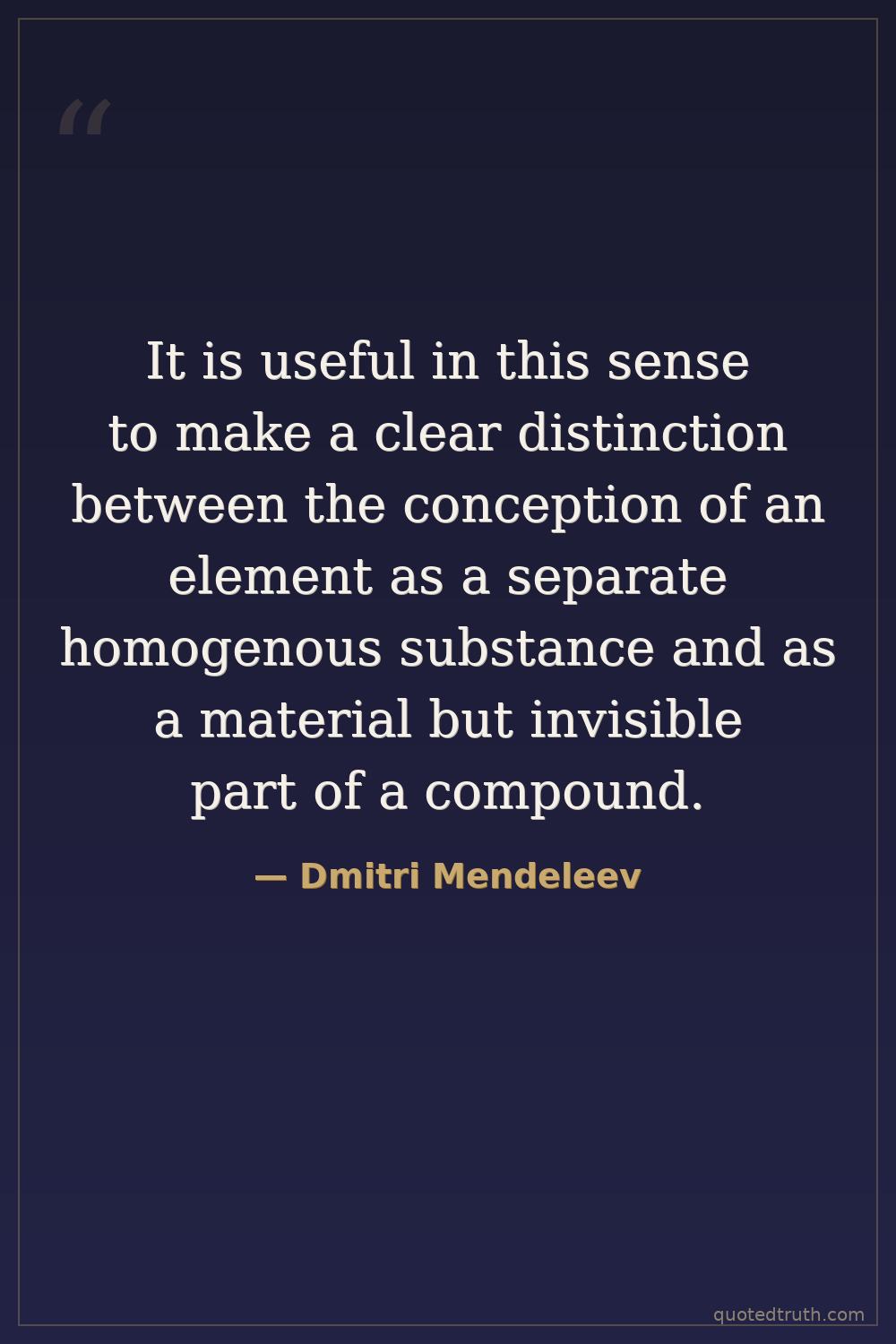
Mendeleev is drawing a line between two ways of thinking about an element. On one hand, an element can exist as a pure substance you can see and handle, like a piece of copper. On the other hand, that same element lives hidden inside compounds, bonded with others, invisible as itself. Understanding chemistry, he argues, requires keeping both ideas separate in your mind.
Relevance to Dmitri Mendeleev
This distinction sits at the heart of Mendeleev's achievement. To build the periodic table in 1869, he had to treat elements as abstract identities defined by atomic weight and properties, not just as lumps of matter. He predicted undiscovered elements like gallium and germanium precisely because he trusted the conceptual element over the visible one, letting pattern guide him toward substances nobody had yet isolated.
The era
Mendeleev worked in late nineteenth-century Russia, when chemistry was transitioning from alchemical tradition into rigorous science. Atoms were still debated, many elements remained undiscovered, and chemists argued fiercely about whether invisible particles were real or mere bookkeeping. His 1869 periodic table arrived amid this ferment, alongside Darwin's evolution and Maxwell's electromagnetism, part of a broader Victorian push to find hidden order beneath surface appearances in nature.
AI-generated insights based on extensive research and information for context. Factual errors? Email [email protected].