Niels Bohr — "It is wrong to think that the task of physics is to find out how nature is. Phys…"
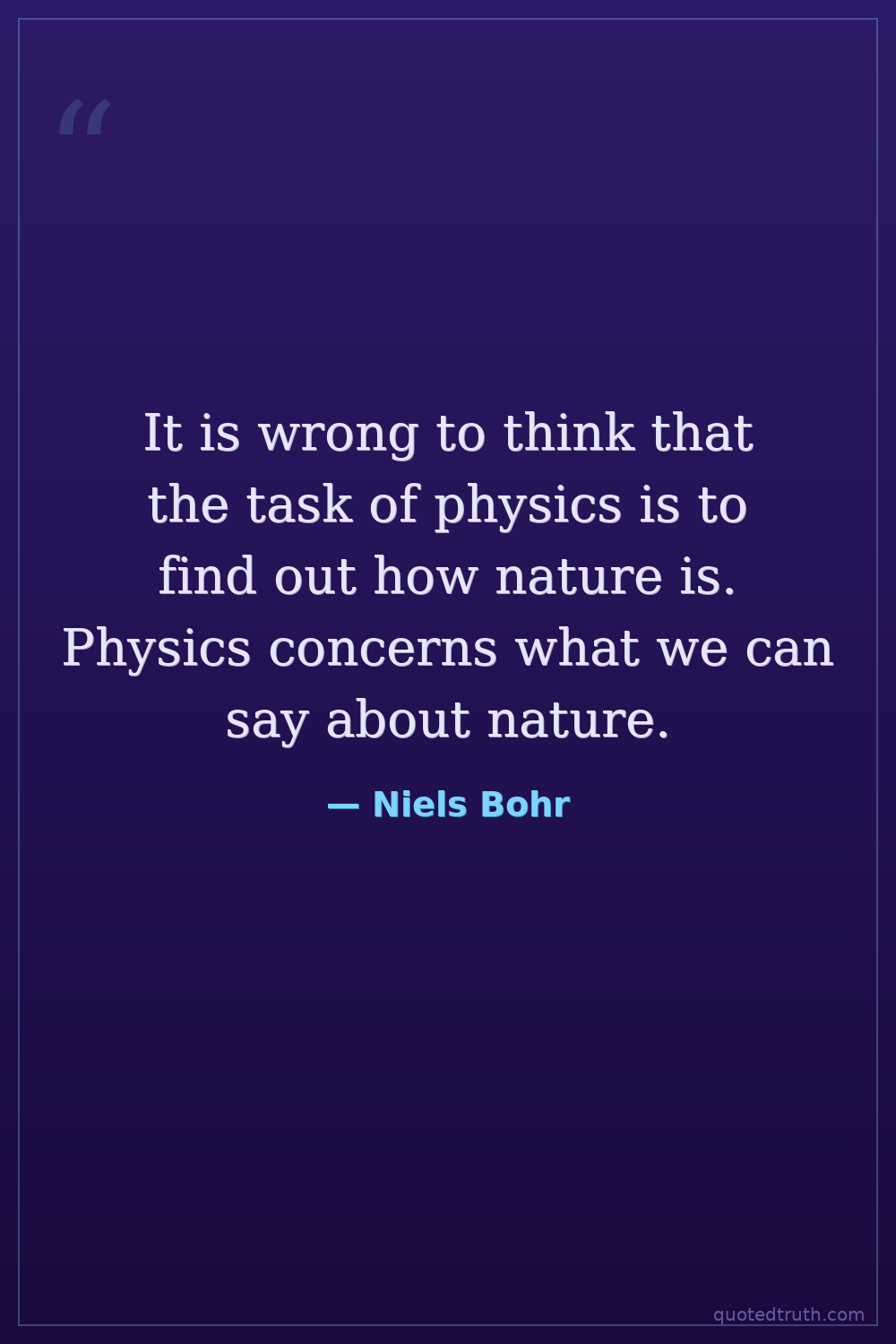
It is wrong to think that the task of physics is to find out how nature is. Physics concerns what we can say about nature.
It is wrong to think that the task of physics is to find out how nature is. Physics concerns what we can say about nature.
Click any product to generate a realistic preview. Up to 3 at a time.
* Initial load can take up to 90 seconds — revising the preview in another color is nearly instant.
"The universe is not only stranger than we imagine, it is stranger than we can imagine."
"No, I certainly do not believe in this superstition. But you know, they say that it does bring luck even if you don't believe in it!"
"The aim of science is to purify our notions, not to increase the number of facts."
"One must be clear that, as far as the atoms are concerned, we are not dealing with an analogy to everyday experience but with something quite different."
"Every sentence I utter must be understood not as an affirmation, but as a question."
Found in 3 providers: grok,deepseek,gemini
3 sources checked
Bohr argues that physics is not about uncovering some absolute, objective reality of nature itself. Instead, it is about what humans can meaningfully describe, measure, and communicate regarding nature through experiments and language. Our theories and equations are tools for talking about observations, not direct windows into an ultimate truth. Science is bounded by what we can observe and express, not by a god's-eye view of reality.
This reflects Bohr's core philosophical stance as founder of the Copenhagen interpretation of quantum mechanics. He insisted observation and measurement define reality at the quantum scale, famously debating Einstein who believed in an objective underlying nature. His atomic model and complementarity principle showed electrons behave according to what experiments ask, making epistemology inseparable from physics in his lifelong worldview.
Bohr spoke during the quantum revolution of the 1920s-30s, when Heisenberg's uncertainty principle and wave-particle duality shattered Newtonian certainty. Physicists confronted experiments where observation altered outcomes, forcing a crisis over what science could claim to know. Against this backdrop, and amid broader modernist doubts about objectivity in philosophy and art, Bohr's statement captured a radical shift: science surrendered its claim to describe reality directly.
AI-generated insights based on extensive research and information for context. Factual errors? Email [email protected].
Your cart is empty