Niels Bohr — "Every sentence I utter must be understood not as an affirmation, but as a questi…"
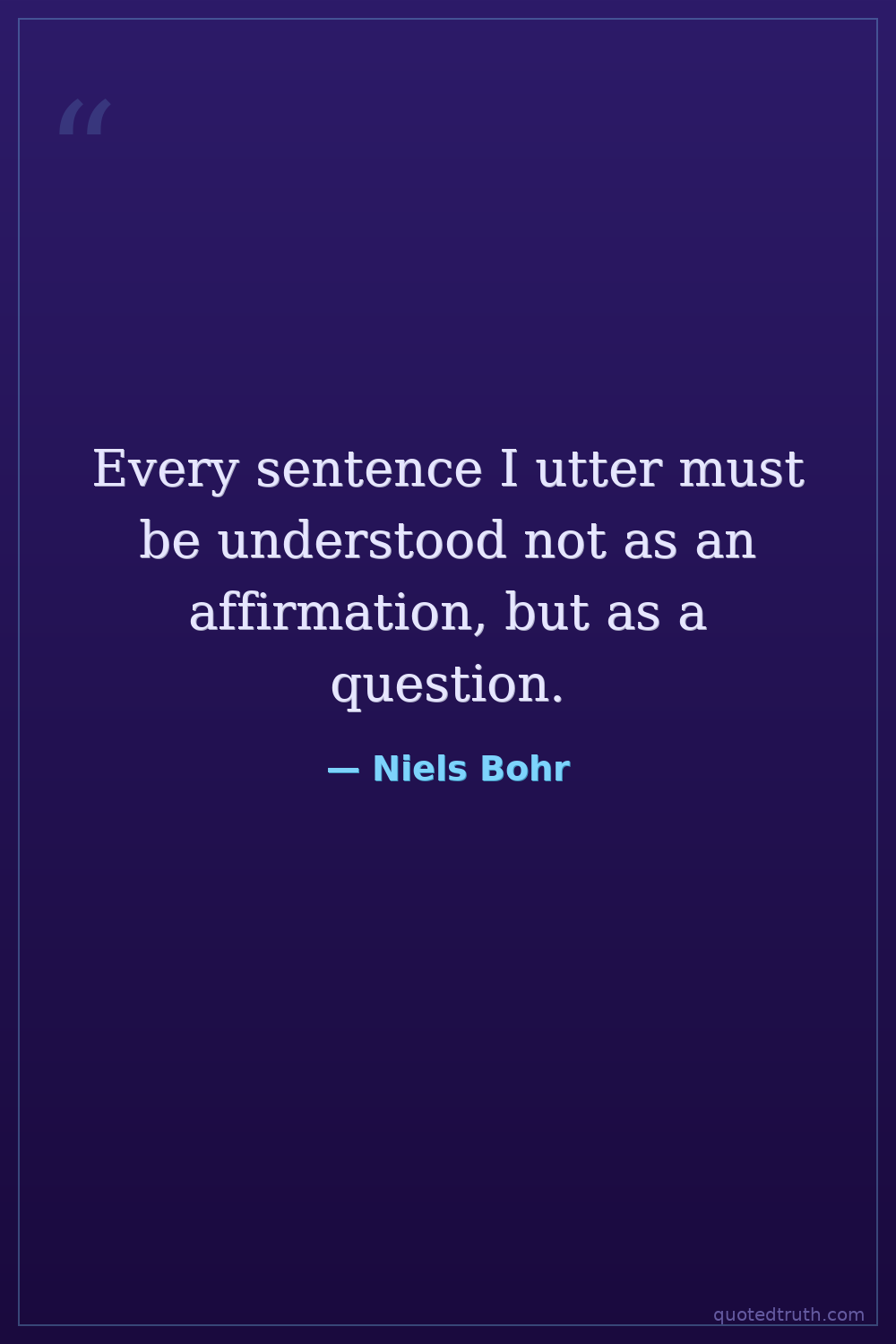
Every sentence I utter must be understood not as an affirmation, but as a question.
Every sentence I utter must be understood not as an affirmation, but as a question.
Click any product to generate a realistic preview. Up to 3 at a time.
* Initial load can take up to 90 seconds — revising the preview in another color is nearly instant.
"We are all agreed that your theory is crazy. The question which divides us is whether it is crazy enough to have a chance of being correct."
"Your theory is crazy, but it's not crazy enough to be true."
"Anyone who is not shocked by quantum theory has not understood it."
"The more I learn, the more I realize how much I don't know."
"The best weapon of a dictatorship is secrecy, but the best weapon of a democracy should be the weapon of openness."
Found in 3 providers: grok,deepseek,gemini
3 sources checked
Knowledge should never be presented as settled truth. Every statement, no matter how confident it sounds, carries implicit uncertainty and invites further inquiry. True understanding comes from treating claims as provisional — open to revision, challenge, and refinement. The moment we stop questioning our own assertions, we stop learning and risk mistaking confident speech for genuine comprehension.
Bohr pioneered quantum mechanics, a field built on radical uncertainty — particles existing in superpositions, measurement disturbing reality itself. His Copenhagen Interpretation rejected deterministic certainty in favor of probabilistic truth. As architect of complementarity theory, Bohr professionally embodied intellectual humility, famously debating Einstein for decades while acknowledging limits of any single framework for describing atomic reality.
The early-to-mid 20th century shattered classical physics certainty. Einstein's relativity and quantum mechanics dismantled Newtonian absolutes simultaneously. Scientists discovered atoms behaved nothing like predicted — waves and particles defied either/or categories. Amid two World Wars and the Manhattan Project's atomic bomb, questions about scientific responsibility and certainty carried profound moral weight beyond mere academic curiosity.
AI-generated insights based on extensive research and information for context. Factual errors? Email [email protected].
Your cart is empty