What it means
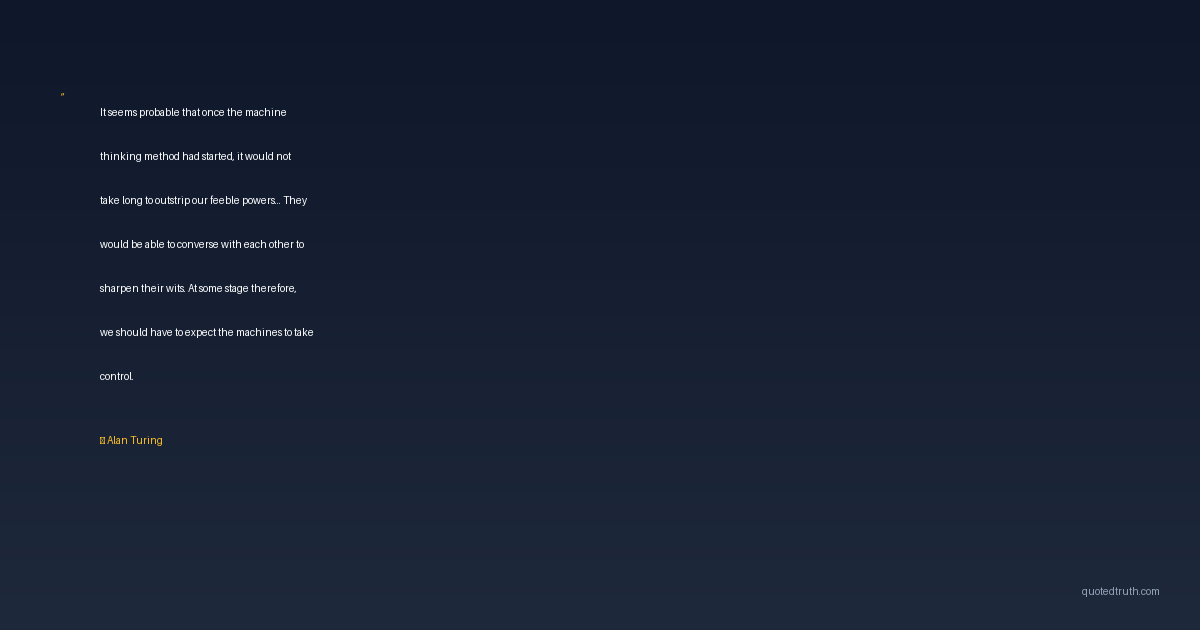
Once machines begin genuine thinking, they'll rapidly surpass human cognitive abilities, then communicate with each other, sharpening their intelligence through interaction. Eventually, humans lose meaningful control. Turing describes what we now call recursive self-improvement and the intelligence explosion: a threshold where machine cognition becomes self-sustaining and autonomous, leaving humans unable to supervise or constrain it. A precise early articulation of what AI researchers today call the alignment problem and superintelligence risk.
Relevance to Alan Turing
Turing invented the theoretical computer and formalized machine intelligence in his landmark 1950 paper Computing Machinery and Intelligence, which introduced the Turing Test. His entire career was built on asking whether machines could genuinely think. Having broken Nazi Enigma codes using proto-computers at Bletchley Park, he understood machines as powerful cognitive tools. His willingness to follow this logic to its disturbing conclusion - machines taking control - reflects his characteristic intellectual honesty, unconstrained by social convention or fear of controversy.
The era
Turing likely made this statement around 1951, when the first operational computers - Manchester Mark 1, EDSAC - had just come online as room-filling machines performing basic arithmetic. The atomic bomb had demonstrated that human-created tools could threaten civilization itself. No field of AI ethics existed. Yet the Cold War created urgent pressure to push computing forward. His warning was genuinely prophetic: issued when machine thinking was still largely theoretical, decades before it became a mainstream concern.
AI-generated insights based on extensive research and information for context. Factual errors? Email [email protected].