What it means
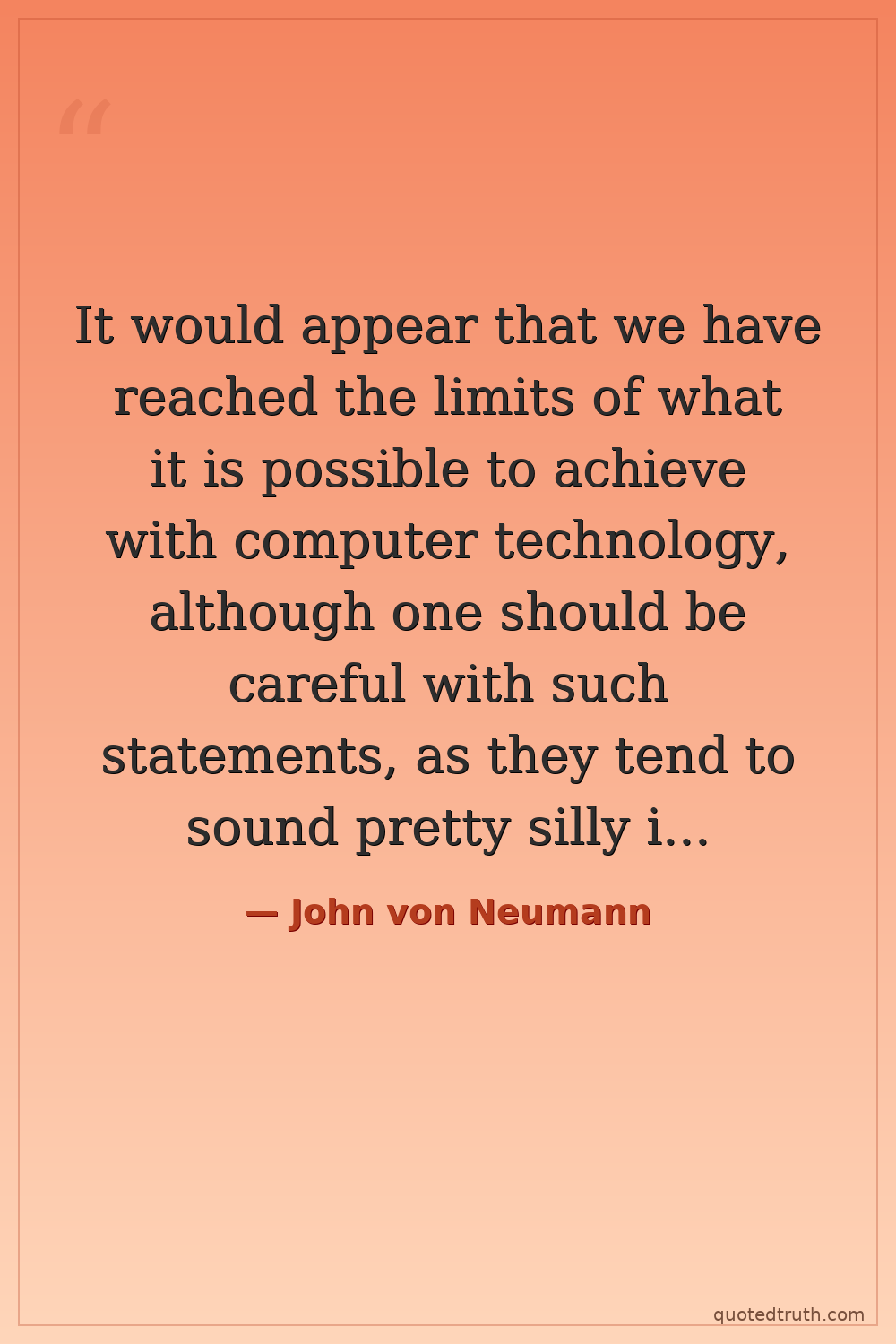
Technological progress routinely outpaces our boldest predictions. The quote warns that declaring any technology has hit its ceiling is almost always wrong — what looks like a hard limit today becomes obsolete within years. It urges humility in forecasting, acknowledging that human ingenuity repeatedly shatters assumed boundaries, and that confident declarations of impossibility are the ones most likely to embarrass their authors.
Relevance to John von Neumann
Von Neumann co-designed the foundational stored-program computer architecture still used today and worked on ENIAC and EDVAC in the 1940s. Having witnessed vacuum-tube machines fill entire rooms to perform basic arithmetic, he understood both the raw potential and perceived ceilings of early computing. His game theory work deepened his appreciation for strategic reasoning under uncertainty, making him acutely aware of how predictions about complex systems routinely fail.
The era
In the late 1940s and early 1950s, computers were room-sized vacuum-tube machines costing millions, accessible only to governments and universities. ENIAC demonstrated electronic calculation in 1945, and the transistor arrived in 1947 but was not yet miniaturized. Experts widely believed computing would remain a niche scientific instrument. The idea of personal computers, let alone pocket-sized devices, was genuinely unimaginable to nearly everyone working in the field.
AI-generated insights based on extensive research and information for context. Factual errors? Email [email protected].