What it means
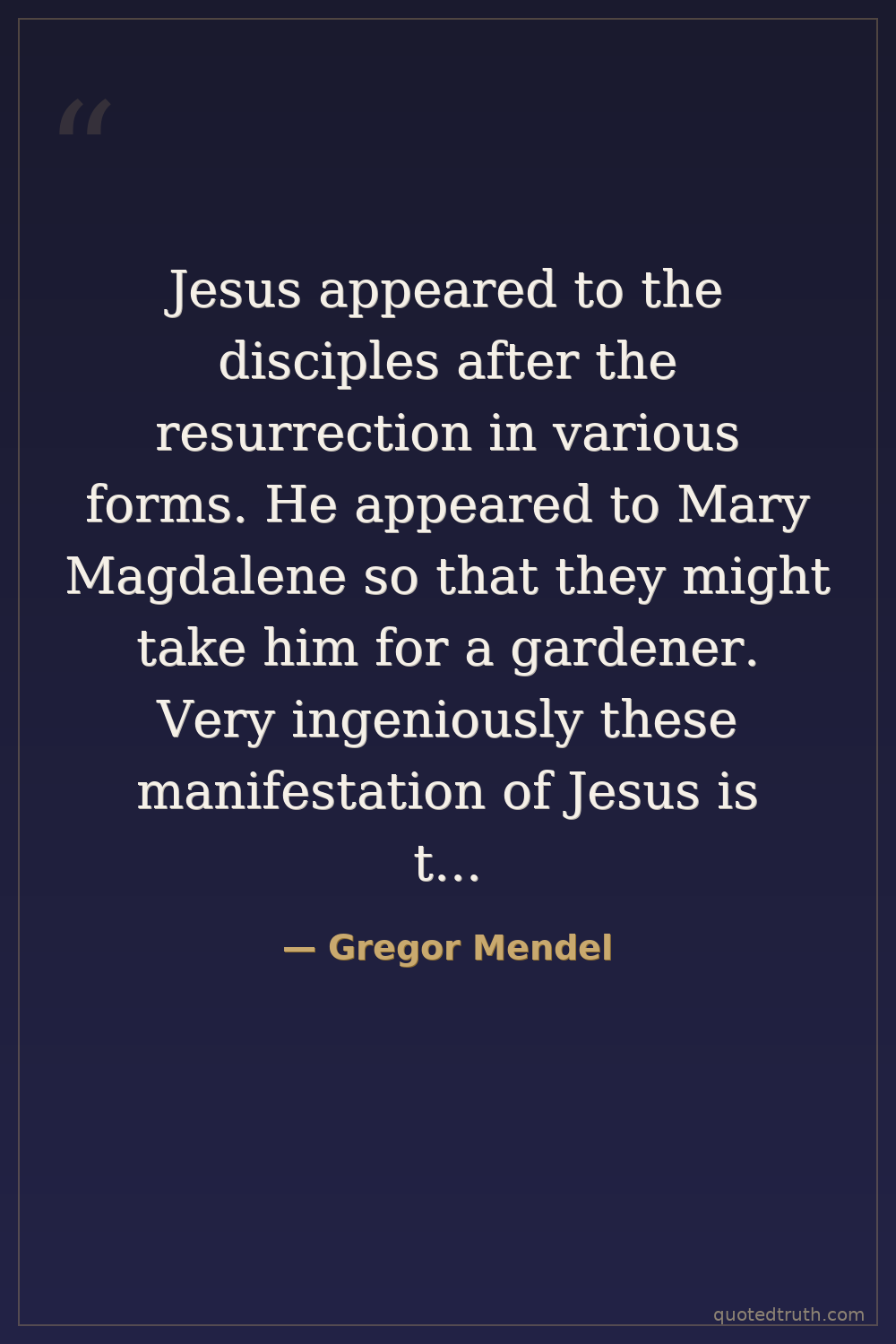
Mendel meditates on Christ appearing to Mary Magdalene after the resurrection, initially mistaken for a gardener. Rather than treating this as mere confusion, he finds it deliberately chosen — Jesus manifests as someone who works with soil and seeds. The gardener plants into prepared ground, suggesting spiritual renewal follows the same purposeful, cultivating logic as agrarian labor: select the right form, prepare the conditions, and growth follows.
Relevance to Gregor Mendel
Mendel was an Augustinian friar at St. Thomas' Abbey in Brno who conducted his heredity experiments in the monastery garden — he literally prepared soil and planted pea seeds daily for years. The risen Christ appearing as a gardener was not abstract theology for him; it described his own vocation. His dual identity as monk and botanist made this image personally resonant, almost autobiographical, collapsing the sacred and the scientific into a single figure.
The era
Darwin's 1859 Origin of Species forced a public reckoning between scripture and natural science across 19th-century Europe. Catholic clergy faced mounting pressure to reconcile faith with empirical observation. Mendel, running his genetics experiments through the 1860s, lived this tension daily. Biblical typology — reading sacred narratives through layered symbolic meaning — gave him an intellectual framework to find scientific resonance in scripture without abandoning either vocation or vow.
AI-generated insights based on extensive research and information for context. Factual errors? Email [email protected].