What it means
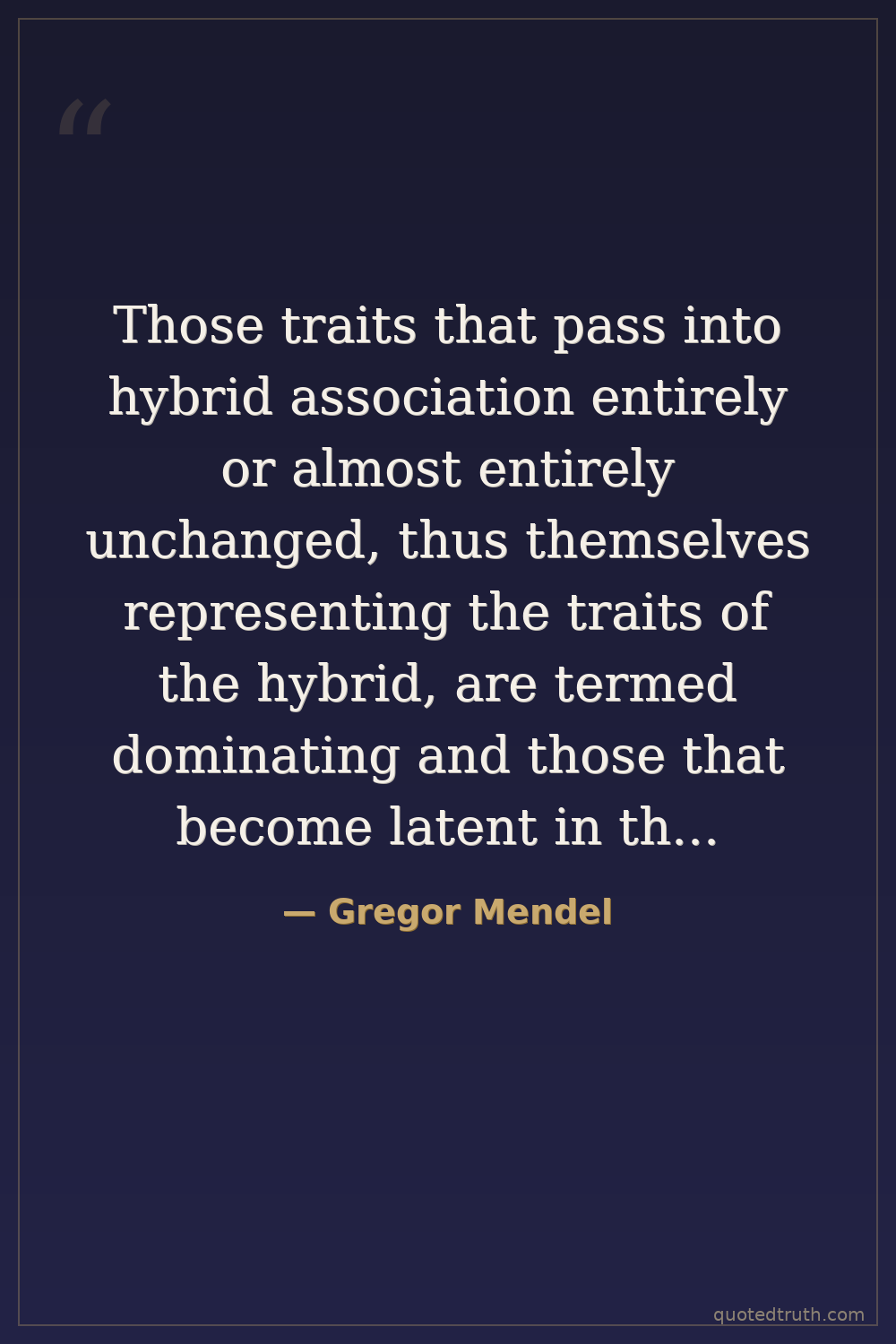
When two parents with different traits produce offspring (hybrids), some traits appear visually intact — these are dominant. Others seem to vanish, hidden beneath the surface — these are recessive. The hidden traits aren't lost; they're simply suppressed. This foundational definition explains why children can resemble grandparents more than parents, and why traits can disappear for generations then reappear. Dominant traits win visually; recessive ones wait silently in the genetic background.
Relevance to Gregor Mendel
Mendel coined "dominant" and "recessive" in his 1865 paper after eight years of meticulous pea plant experiments in his monastery garden in Brno. An Augustinian friar with formal physics training, he brought mathematical rigor to biology when others relied purely on observation. He worked in obscurity, never receiving recognition in his lifetime — his paper went unread for 35 years. His patient, systematic temperament is embodied in this precise, definitional language.
The era
In 1865, Darwin's evolution theory was only six years old, yet nobody understood the mechanism of inheritance. Blending inheritance — the idea that traits simply average together in offspring — was the prevailing assumption. Mendel shattered this by demonstrating discrete, countable units of heredity with predictable ratios. Before genetics existed as a field, before chromosomes were understood, this quote defined the invisible architecture underlying all biological inheritance, published in an obscure regional journal to complete silence.
AI-generated insights based on extensive research and information for context. Factual errors? Email [email protected].