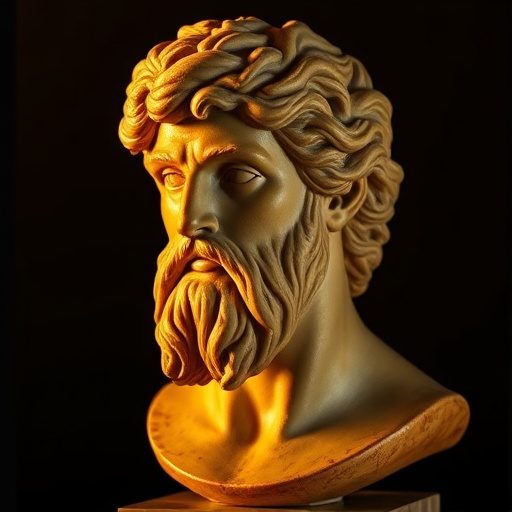
Pythagoras — "Leave not a trace of the pot in the ashes."
Leave not a trace of the pot in the ashes.
Leave not a trace of the pot in the ashes.
Click any product to generate a realistic preview. Up to 3 at a time.
* Initial load can take up to 90 seconds — revising the preview in another color is nearly instant.
"Respect yourself, and others will respect you."
"You should make great things, not promising great things."
"In no way neglect the health of your body; But give it drink and food in due measure, and also the exercise of which it has need."
"Number is the ruler of forms and ideas, and the cause of gods and daemons."
"A fool is known by his speech, and a wise man by silence."
Greek philosopher and mathematician whose school in Croton combined geometry (the Pythagorean theorem), number-mysticism, and a religious-vegetarian way of life. Closely associated with Thales of Miletus (earlier pre-Socratic and the first philosopher). For an intellectual contrast, see Heraclitus, pre-Socratic Greek philosopher of flux — Heraclitus called Pythagoras 'the chief of swindlers' — among the founding insults of the philosophical-rivalry tradition. Their 'all is flux' vs 'all is number' poles still organize the philosophy of mathematics today (Platonist vs anti-realist).
One of the 'symbols' or maxims, interpreted in various ways, e.g., don't harbor resentment, don't leave things unfinished.
Date: c. 570 – c. 495 BC
ShockingFound in 1 providers: grok
1 source checked
Don't leave any remnant or trace of what you've used or done — complete your actions fully and cleanly, leaving nothing behind. In modern terms: finish things properly, clean up entirely after yourself, and don't let past activities leave lingering marks. It's a call for thoroughness and discipline — whether applied literally to tidying up or symbolically to releasing the past without residue or attachment.
Pythagoras led a tightly governed philosophical community bound by cryptic symbolic rules called akousmata — short maxims guiding daily behavior. His emphasis on mathematical precision and harmonic purity extended into ethical living: no loose ends, no impurity. This quote mirrors his belief that disciplined conduct requires complete, conscious action. As someone who built an entire worldview on exact relationships — in numbers and in character — leaving no trace was a core virtue.
In 6th-century BCE Greece, the hearth was sacred to Hestia and central to domestic and civic ritual. Carelessness around fire and ashes carried genuine spiritual weight. Pythagorean communities observed strict purity codes governing food, fire, and bodily conduct. Leaving a pot's mark in sacred ashes suggested impiety or negligence. This saying reflects the era's conviction that proper ritual behavior — even in mundane acts — maintained harmony between humans and the divine order.
AI-generated insights based on extensive research and information for context. Factual errors? Email [email protected].
Your cart is empty