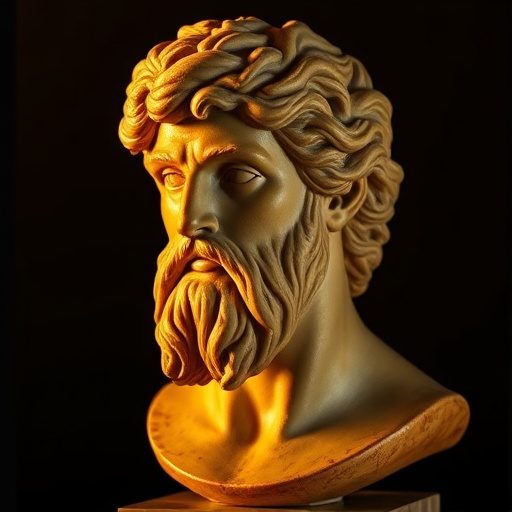
Pythagoras — "A fool is known by his speech, and a wise man by silence."
A fool is known by his speech, and a wise man by silence.
A fool is known by his speech, and a wise man by silence.
Click any product to generate a realistic preview. Up to 3 at a time.
* Initial load can take up to 90 seconds — revising the preview in another color is nearly instant.
"The strangest (and sexiest) of the legends surrounding the aura of Pythagoras is that he had a golden thigh that he would show to impress people he wanted to join his cult."
"No one is free who has not obtained the empire of himself. No man is free who cannot command himself."
"Wisdom thoroughly learned will never be forgotten."
"It is difficult to walk at one and the same time on a single path and on many."
"Choose rather to be strong of soul than strong of body."
Greek philosopher and mathematician whose school in Croton combined geometry (the Pythagorean theorem), number-mysticism, and a religious-vegetarian way of life. Closely associated with Thales of Miletus (earlier pre-Socratic and the first philosopher). For an intellectual contrast, see Heraclitus, pre-Socratic Greek philosopher of flux — Heraclitus called Pythagoras 'the chief of swindlers' — among the founding insults of the philosophical-rivalry tradition. Their 'all is flux' vs 'all is number' poles still organize the philosophy of mathematics today (Platonist vs anti-realist).
Contrasting the outward expression of folly with the inward wisdom of restraint.
Date: c. 5th Century BCE
PhilosophicalFound in 1 providers: gemini
1 source checked
The saying draws a sharp line between two kinds of people based on how they use their voice. Fools give themselves away the moment they open their mouths, babbling opinions and revealing ignorance. Wise people hold back, listening and thinking before speaking, and often choosing not to speak at all. Restraint signals depth; chatter signals emptiness. In short, your words expose you, so speak less and you will seem, and become, wiser.
Pythagoras ran a tight philosophical brotherhood in southern Italy where new initiates were required to take a vow of silence lasting up to five years before they could speak in discussions. Disciplined silence was a core training tool for him, meant to sharpen listening, memory, and self-control. As a mathematician and mystic who guarded his teachings closely, he practiced exactly what this saying preaches: measured speech, secrecy, and the conviction that inner order mattered more than public display.
In the 6th century BCE Greek world, reputation was built in the agora through oratory, poetry contests, and political debate, where loud, clever speakers won influence. Sophists and rhetoricians who later dominated Greek culture were already emerging, prizing persuasion over truth. Against that noisy backdrop, Pythagoras's school in Croton stood out by demanding silence, secrecy, and contemplation. The saying pushes back on a civilization that equated eloquence with wisdom, insisting instead that restraint, not performance, revealed a truly ordered mind.
AI-generated insights based on extensive research and information for context. Factual errors? Email [email protected].
Your cart is empty