Euclid — "Let it be granted that a finite straight line may be produced to any length in a…"
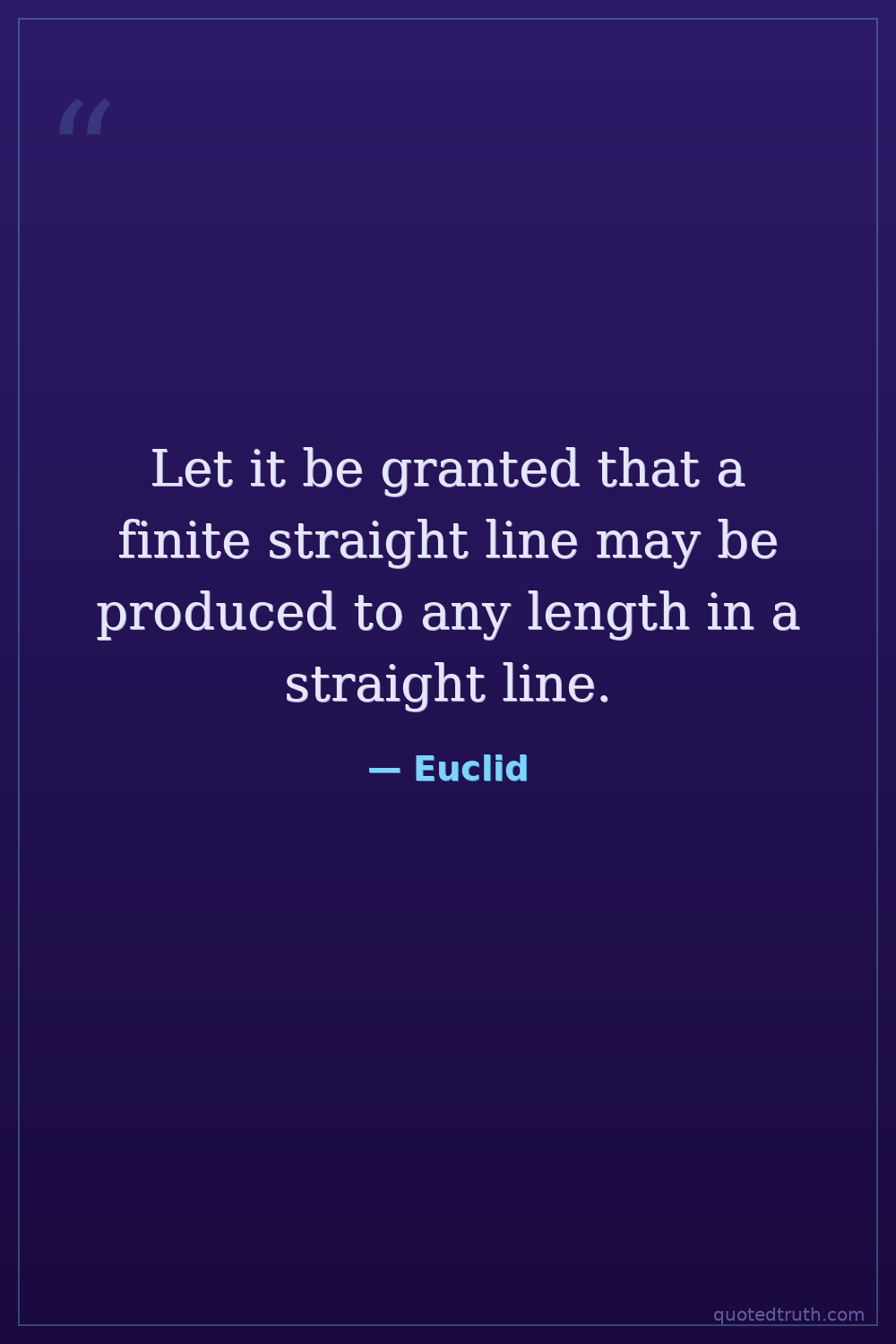
Let it be granted that a finite straight line may be produced to any length in a straight line.
Let it be granted that a finite straight line may be produced to any length in a straight line.
Click any product to generate a realistic preview. Up to 3 at a time.
* Initial load can take up to 90 seconds — revising the preview in another color is nearly instant.
"Let it be granted that a circle may be described with any center and any radius."
"If a straight line be drawn from the ends of a straight line, it will be a triangle."
"If a straight line fall on two parallel straight lines, it makes the alternate angles equal to one another, the exterior angle equal to the interior and opposite angle, and the interior angles on the …"
"A semicircle is the figure contained by the diameter and the circumference cut off by it. And the center of the semicircle is the same as that of the circle."
"Trilateral figures are those contained by three straight lines, quadrilateral those contained by four, and multilateral those contained by more than four straight lines."
Found in 2 providers: grok,gemini
2 sources checked
Any finite line segment can be extended indefinitely in either direction without limit. In modern terms, this asserts that space has no edges or walls — you can always go further. It is a foundational assumption that geometry operates in infinite, continuous space, enabling constructions of any scale and making Euclidean proofs universally applicable rather than constrained to a bounded region.
Euclid wrote Elements around 300 BCE in Alexandria — the most influential mathematics textbook in history, building all geometry from just five postulates. This is his Second Postulate, minimal but powerful. It captures his core method: identify the irreducible axioms, state them plainly, and derive complex truths through pure logical deduction. His entire career was devoted to exactly this kind of rigorous, systematic reasoning.
Ancient Greek philosophers fiercely debated infinity. Aristotle argued only potential infinity exists — you can always extend further but never reach an actual end. Euclid wrote Elements around 300 BCE in Alexandria, then the world's leading center of scholarship. His postulate embodied Greek mathematical caution: assert only that lines may be prolonged, not that infinite lengths exist, keeping geometry both rigorous and philosophically defensible.
AI-generated insights based on extensive research and information for context. Factual errors? Email [email protected].
Your cart is empty