What it means
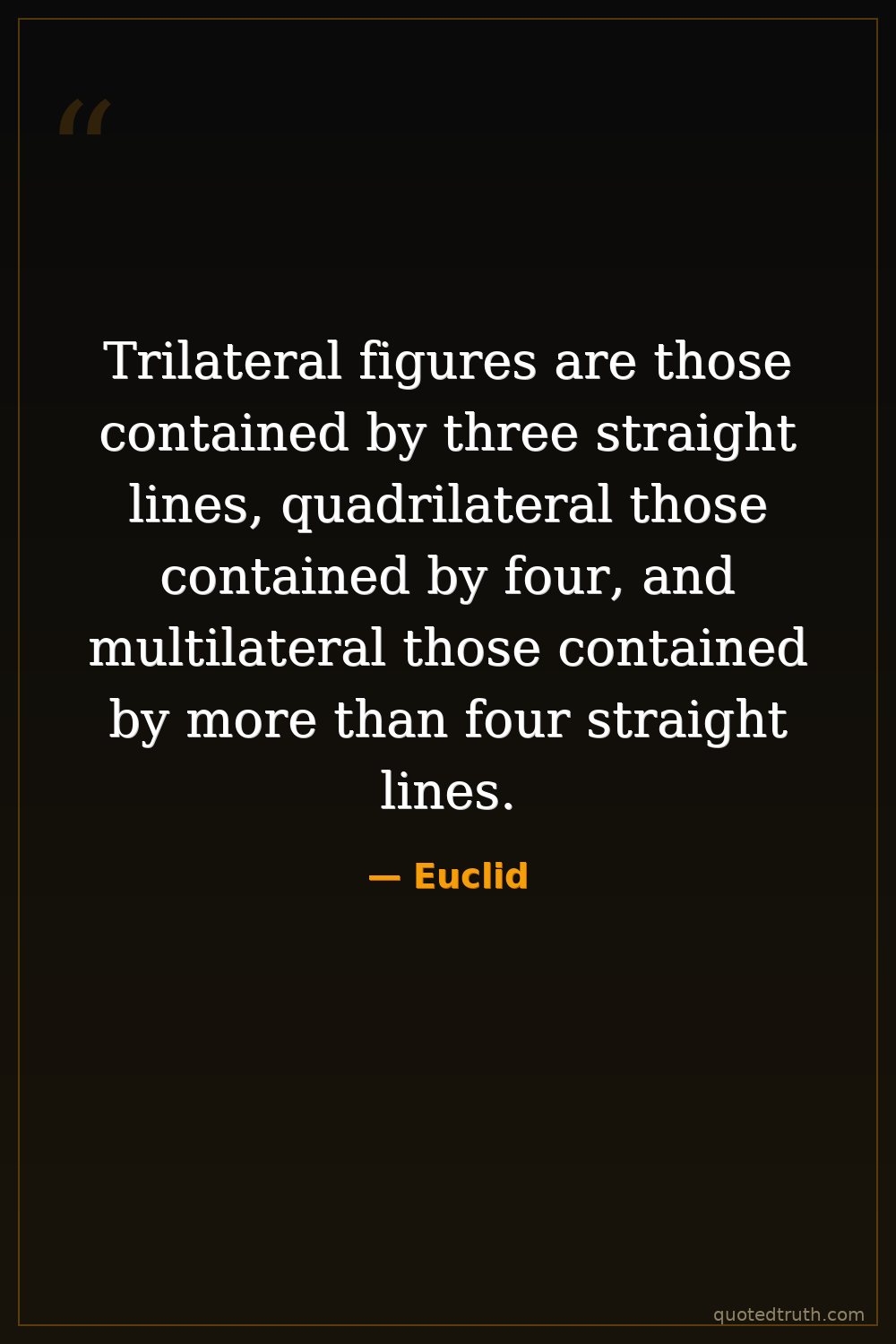
Shapes are defined by how many straight lines enclose them: three lines make a triangle, four make a quadrilateral, and any figure bounded by more than four straight lines is multilateral. This is a precise definitional statement, establishing clear categories for polygons based on their bounding edges, giving readers an exact, unambiguous framework for classifying flat figures by their sides.
Relevance to Euclid
Euclid built mathematics on rigorous definitions before proofs, and this exemplifies that method. In his Elements, he began each book with definitions to eliminate ambiguity. As the systematizer of Greek geometry, Euclid believed knowledge required unshakeable foundations. This definition reflects his conviction that clarity in terminology was not pedantry but the essential precondition for logical reasoning and mathematical truth.
The era
Around 300 BCE in Alexandria, Greek thinkers were transforming philosophy into systematic science. Euclid worked under Ptolemy I, whose Museum and Library made Alexandria the intellectual capital of the ancient world. Greek culture prized logos—rational order—and geometry was considered the highest form of knowledge. Defining shapes precisely reflected broader Greek efforts to impose rational structure on nature, moving beyond mythology toward demonstrable, universal truths.
AI-generated insights based on extensive research and information for context. Factual errors? Email [email protected].