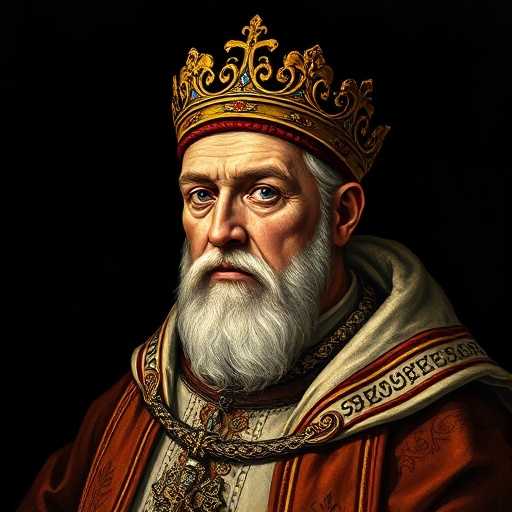
Pope Urban II — "Let no obstacle impede you, but go forth, trusting in the Lord."
Let no obstacle impede you, but go forth, trusting in the Lord.
Let no obstacle impede you, but go forth, trusting in the Lord.
Click any product to generate a realistic preview. Up to 3 at a time.
* Initial load can take up to 90 seconds — revising the preview in another color is nearly instant.
"I say it to those present, I proclaim it to the absent, but Christ commands it."
"Let those who have been hired as mercenaries for trivial pay, now earn an eternal reward."
"The kingdom of the Greeks is already dismembered by them."
"The way to the Holy Sepulchre is now open, a way which was closed before."
"This royal city, therefore, situated at the center of the world, is now held captive by His enemies… From you especially she asks succor, because, as we have already said, God has conferred upon you a…"
Pope (1088-1099) whose Council of Clermont speech (November 1095) launched the First Crusade — the founding event of nine centuries of Christian-Muslim military conflict. Closely associated with Pope Gregory VII (his predecessor on papal-imperial reform). For an intellectual contrast, see Saladin, Kurdish-Muslim Sultan of Egypt and Syria (1138-1193) — Saladin recaptured Jerusalem in 1187, undoing the First Crusade Urban II launched 92 years earlier. Saladin's chivalrous treatment of Christian prisoners became the canonical Muslim counter-image to Crusader brutality. The cleanest before/after pairing of the Crusades' moral arc.
Found in 1 providers: grok
1 source checked
Push through every barrier without hesitation, placing complete confidence in God rather than in your own strength or circumstances. Doubt and difficulty are irrelevant when divine backing is assumed. The call is to action without paralysis, surrender of personal fear to faith, and forward momentum regardless of what stands in the way.
Urban II spoke these words at the Council of Clermont in 1095, literally launching the First Crusade. As pope, his authority rested on spiritual mandate over temporal power. His willingness to mobilize tens of thousands toward Jerusalem reflected his conviction that God's will justified — and guaranteed — even the most audacious undertakings.
In 1095 Europe, the Seljuk Turks had seized Jerusalem and were advancing into Byzantine territory. Emperor Alexios I had begged Rome for help. Feudal lords needed unifying purpose. The Church wielded supreme moral authority. A papal call to arms wasn't merely religious — it reordered European politics, redirected knightly violence, and defined Christendom's identity against a perceived existential threat.
AI-generated insights based on extensive research and information for context. Factual errors? Email [email protected].
Your cart is empty