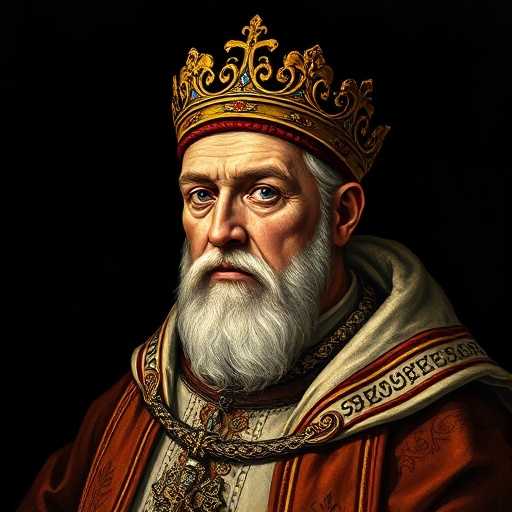
Pope Urban II — "Let no one, on account of his possessions, hesitate to set out."
Let no one, on account of his possessions, hesitate to set out.
Let no one, on account of his possessions, hesitate to set out.
Click any product to generate a realistic preview. Up to 3 at a time.
* Initial load can take up to 90 seconds — revising the preview in another color is nearly instant.
"That royal city, Jerusalem, situated in the middle of the world, is now held captive by its enemies."
"Undertake this journey for the remission of your sins, with the assurance of the imperishable glory of the kingdom of heaven."
"Let no delay postpone the journey, but let all, having leased their lands and collected money, when winter has ended and spring has begun, zealously set out on the road with God as their guide."
"Let those who have been exhausting themselves to the detriment both of body and soul now strive for a twofold reward."
"Take the road to the Holy Sepulchre, and rescue it from the hands of the pagans."
Pope (1088-1099) whose Council of Clermont speech (November 1095) launched the First Crusade — the founding event of nine centuries of Christian-Muslim military conflict. Closely associated with Pope Gregory VII (his predecessor on papal-imperial reform). For an intellectual contrast, see Saladin, Kurdish-Muslim Sultan of Egypt and Syria (1138-1193) — Saladin recaptured Jerusalem in 1187, undoing the First Crusade Urban II launched 92 years earlier. Saladin's chivalrous treatment of Christian prisoners became the canonical Muslim counter-image to Crusader brutality. The cleanest before/after pairing of the Crusades' moral arc.
Found in 1 providers: grok
1 source checked
Don't let what you own stop you from acting. The quote urges people not to use wealth or property as an excuse for inaction — arguing that a greater mission demands movement regardless of material cost. It frames hesitation rooted in possessions as a moral failure, calling on people to prioritize something higher over financial security or the fear of losing what they've built.
Urban II delivered this at the Council of Clermont in 1095, knowing his audience: feudal knights bound to their estates. A Cluniac monk turned pope, he understood that Church reform required sacrifice above comfort. His papacy constantly navigated tension between spiritual authority and worldly entanglement. This line directly addresses the primary practical objection his audience faced — abandoning land, income, and family to fight thousands of miles away in the Holy Land.
In 1095 Europe, land was identity. Feudal lords derived power, income, and status entirely from their estates — leaving meant genuine financial and political risk. The Seljuk Turks had seized much of Anatolia, cutting Christian pilgrimage routes to Jerusalem. Urban needed to overcome a concrete economic obstacle: convincing property-owning warriors that spiritual redemption and papal indulgence outweighed the material cost of a years-long military campaign in hostile foreign territory.
AI-generated insights based on extensive research and information for context. Factual errors? Email [email protected].
Your cart is empty