Pope Urban II — "Undertake this journey for the remission of your sins, with the assurance of the…"
Undertake this journey for the remission of your sins, with the assurance of the imperishable glory of the kingdom of heaven.
Undertake this journey for the remission of your sins, with the assurance of the imperishable glory of the kingdom of heaven.
Click any product to generate a realistic preview. Up to 3 at a time.
* Initial load can take up to 90 seconds — revising the preview in another color is nearly instant.
"We absolve all who undertake this journey from all penance for their sins."
"Let those who have been hired as mercenaries for trivial pay, now earn an eternal reward."
"Warriors who hear my voice, you who will go to war, rejoice, because you are taking up a legitimate war… Arm yourselves with the sword of the Maccabees and go to defend the house of Israel who is the …"
"Therefore, I pray and exhort, nay not I, but the Lord prays and exhorts you, as heralds of Christ, to urge men of all ranks, knights and foot-soldiers, rich and poor, to hasten to exterminate this vil…"
"If you are conquered, you will have the glory of those who die for Christ."
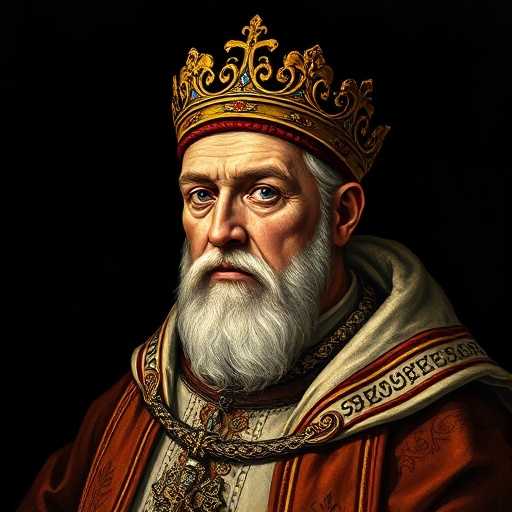
Pope (1088-1099) whose Council of Clermont speech (November 1095) launched the First Crusade — the founding event of nine centuries of Christian-Muslim military conflict. Closely associated with Pope Gregory VII (his predecessor on papal-imperial reform). For an intellectual contrast, see Saladin, Kurdish-Muslim Sultan of Egypt and Syria (1138-1193) — Saladin recaptured Jerusalem in 1187, undoing the First Crusade Urban II launched 92 years earlier. Saladin's chivalrous treatment of Christian prisoners became the canonical Muslim counter-image to Crusader brutality. The cleanest before/after pairing of the Crusades' moral arc.
Found in 1 providers: grok
1 source checked
Take up this military pilgrimage and your sins will be wiped clean—heaven is guaranteed. It reframes warfare as a sacred transaction: earthly violence converts into spiritual credit. The soldier doesn't just fight; he earns salvation. The journey itself becomes the penance, suffering becomes the payment, and divine glory the promised return. Violence is sanctified through purpose, and death in its service is rebranded as martyrdom.
Urban II, a Cluniac monk turned pope, was shaped by the Gregorian Reform—a movement obsessed with sin, priestly purity, and ecclesiastical authority. At the Council of Clermont in 1095, he deployed the Church's most potent tool: the plenary indulgence. His monastic formation made penitential theology central to his thinking. By promising remission, he didn't just recruit soldiers—he acted as a spiritual broker between warriors and God, which was exactly his role as pope.
In 1095, Jerusalem had been under Seljuk control since 1071, and Byzantine Emperor Alexios I was pleading for Western military aid. Medieval Europe operated under a framework where sin required active penance—confession alone wasn't enough. The feudal class was trained for violence but spiritually compromised by it. The Church, recovering from the Investiture Controversy, needed to reassert authority. Crusading offered a solution: channel knightly violence outward toward a holy objective under papal direction.
AI-generated insights based on extensive research and information for context. Factual errors? Email [email protected].
Your cart is empty