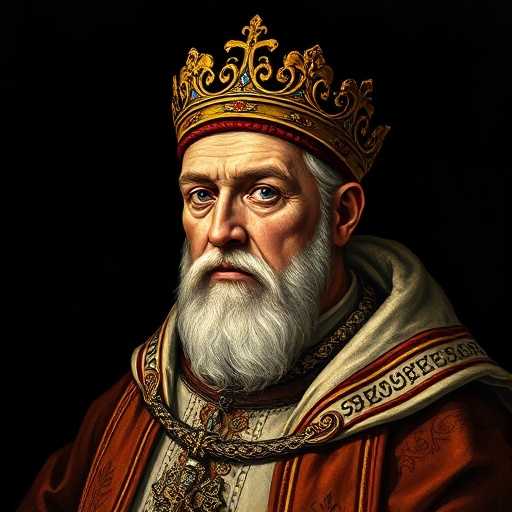
Pope Urban II — "Let no one, on account of his love for his wife or children, hesitate to set out…"
Let no one, on account of his love for his wife or children, hesitate to set out.
Let no one, on account of his love for his wife or children, hesitate to set out.
Click any product to generate a realistic preview. Up to 3 at a time.
* Initial load can take up to 90 seconds — revising the preview in another color is nearly instant.
"Oh, race of Franks, race from across the mountains, race chosen and beloved by God as shines forth in very many of your works... We wish you to know what a grievous cause has led us to your country, w…"
"Let those who have been accustomed to make private war against the faithful carry on an approved war against the infidels."
"From the confines of Jerusalem and the city of Constantinople a horrible tale has gone forth and very frequently has been brought to our ears, namely, that a race from the kingdom of the Persians, an …"
"Remember that you were born of noble blood, and do not degenerate from the valor of your ancestors, but remember their deeds."
"Let those who have formerly contended against their brothers and relatives now fight as they ought against the barbarians."
Pope (1088-1099) whose Council of Clermont speech (November 1095) launched the First Crusade — the founding event of nine centuries of Christian-Muslim military conflict. Closely associated with Pope Gregory VII (his predecessor on papal-imperial reform). For an intellectual contrast, see Saladin, Kurdish-Muslim Sultan of Egypt and Syria (1138-1193) — Saladin recaptured Jerusalem in 1187, undoing the First Crusade Urban II launched 92 years earlier. Saladin's chivalrous treatment of Christian prisoners became the canonical Muslim counter-image to Crusader brutality. The cleanest before/after pairing of the Crusades' moral arc.
Found in 1 providers: grok
1 source checked
A direct command to override personal loyalty to family in service of a greater mission. Urban II is telling men not to let love for wives and children become an excuse for inaction. The message: the cause demands precedence over domestic comfort. He's preemptively neutralizing the most emotionally powerful reason to stay home, framing hesitation as a moral failure rather than a reasonable human instinct.
Urban II was a Benedictine monk who had already renounced family and domestic life before becoming pope, making this detachment personally embodied. At the Council of Clermont in 1095, he delivered this call to arms while offering full remission of sins to those who answered. His monastic formation made earthly love secondary by design, yet he understood it was the primary obstacle laymen faced, so he systematically dismantled it with theological authority.
In 1095, feudal bonds tied men to land, lord, and family, making years-long absence genuinely catastrophic. Seljuk Turkish expansion had disrupted Christian pilgrimage routes to Jerusalem, and Byzantine Emperor Alexios I had urgently appealed to Rome for military aid. Medieval theology ranked earthly attachments below spiritual duties, and Urban's promise of full remission of sins gave crusaders a framework where leaving family was not abandonment but righteous sacrifice within the dominant moral logic of the age.
AI-generated insights based on extensive research and information for context. Factual errors? Email [email protected].
Your cart is empty