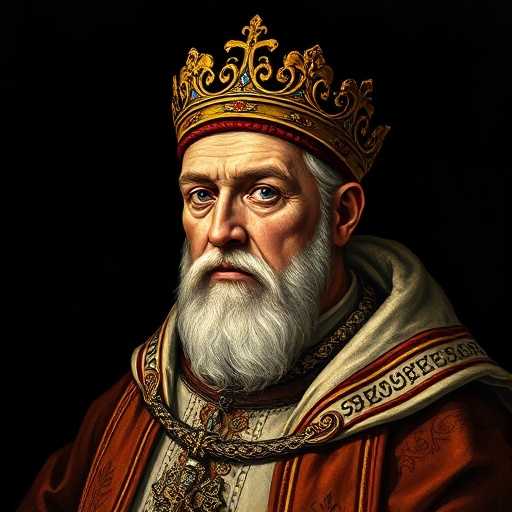
Pope Urban II — "Let the Holy Sepulchre of the Lord our Saviour, which is possessed by unclean na…"
Let the Holy Sepulchre of the Lord our Saviour, which is possessed by unclean nations, incite you to action.
Let the Holy Sepulchre of the Lord our Saviour, which is possessed by unclean nations, incite you to action.
Click any product to generate a realistic preview. Up to 3 at a time.
* Initial load can take up to 90 seconds — revising the preview in another color is nearly instant.
"Let no delay postpone the journey, but let all, having leased their lands and collected money, when winter has ended and spring has begun, zealously set out on the road with God as their guide."
"Let no one who has entered upon this pilgrimage turn back."
"Let none of your possessions detain you, no solicitude for your family affairs, since this land which you inhabit, shut in on all sides by the seas and surrounded by the mountain peaks, is too narrow …"
"Consider that the Holy Spirit has inspired you, and that the Lord has chosen you, that you may show to the world what true valor is, and what a glorious victory may be obtained by those who fight for …"
"Arise, then, and go against this wicked race, and fight for the people of God!"
Pope (1088-1099) whose Council of Clermont speech (November 1095) launched the First Crusade — the founding event of nine centuries of Christian-Muslim military conflict. Closely associated with Pope Gregory VII (his predecessor on papal-imperial reform). For an intellectual contrast, see Saladin, Kurdish-Muslim Sultan of Egypt and Syria (1138-1193) — Saladin recaptured Jerusalem in 1187, undoing the First Crusade Urban II launched 92 years earlier. Saladin's chivalrous treatment of Christian prisoners became the canonical Muslim counter-image to Crusader brutality. The cleanest before/after pairing of the Crusades' moral arc.
Found in 1 providers: grok
1 source checked
The burial place of Jesus Christ in Jerusalem is controlled by people who do not share your faith — let that outrage drive you to fight. This is a direct call to holy war, using Christianity's most sacred site as emotional fuel. It frames military conquest as religious duty, positioning the Crusade not as territorial aggression but as righteous liberation of a desecrated space that every Christian holds central to their salvation.
Urban II delivered this call at the Council of Clermont in 1095, the defining act of his papacy. A Cluniac monk turned reformist pope, he believed in elevating Church authority above secular power. Centering the Crusade on Christ's tomb was tactically and theologically shrewd: it unified fractious European nobility under papal leadership and gave knights a sacred mission. Urban died in 1099 just weeks after Jerusalem fell, never learning his campaign had succeeded.
In 1095, Seljuk Turkish expansion had disrupted Christian pilgrimage routes to Jerusalem, and Byzantine Emperor Alexios I appealed to Rome for military aid. European knights lived in a culture saturated with pilgrimage devotion and the theology of holy war. Jerusalem was considered the literal center of the world, with medieval maps placing it there, and the Holy Sepulchre was Christianity's supreme sacred site. Urban's appeal converted personal piety into collective military mobilization, channeling Europe's warrior class toward papal strategic goals.
AI-generated insights based on extensive research and information for context. Factual errors? Email [email protected].
Your cart is empty