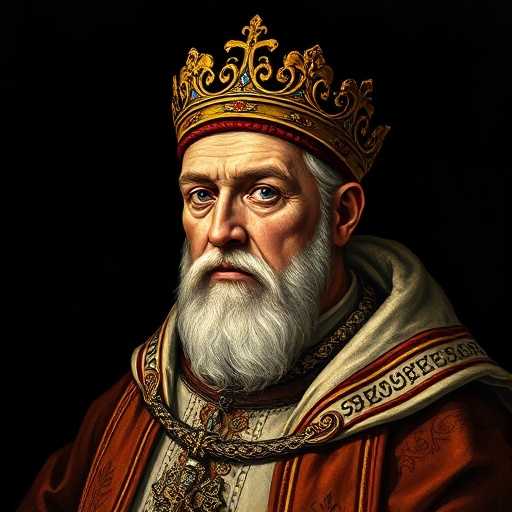
Pope Urban II — "Let the rich help the poor, and the poor help the rich."
Let the rich help the poor, and the poor help the rich.
Let the rich help the poor, and the poor help the rich.
Click any product to generate a realistic preview. Up to 3 at a time.
* Initial load can take up to 90 seconds — revising the preview in another color is nearly instant.
"All who are burdened with debt and wish to escape it, let them join this holy expedition."
"We, by the authority of Almighty God and of the blessed apostles Peter and Paul, grant to all who undertake this expedition remission of sins."
"Let those who for a long time, have been robbers, now become knights."
"For the land which you inhabit, shut in on all sides by the seas and surrounded by the mountain peaks, is too narrow for your large population."
"Let those who have been hired as mercenaries for trivial pay, now earn an eternal reward."
Pope (1088-1099) whose Council of Clermont speech (November 1095) launched the First Crusade — the founding event of nine centuries of Christian-Muslim military conflict. Closely associated with Pope Gregory VII (his predecessor on papal-imperial reform). For an intellectual contrast, see Saladin, Kurdish-Muslim Sultan of Egypt and Syria (1138-1193) — Saladin recaptured Jerusalem in 1187, undoing the First Crusade Urban II launched 92 years earlier. Saladin's chivalrous treatment of Christian prisoners became the canonical Muslim counter-image to Crusader brutality. The cleanest before/after pairing of the Crusades' moral arc.
Found in 1 providers: grok
1 source checked
The quote argues that economic support should run in both directions. Wealthy people owe the poor charity, patronage, and protection; the poor return labor, loyalty, and prayers that medieval thinkers believed spiritually benefited their benefactors. It rejects pure one-directional almsgiving in favor of a mutual-obligation model: society holds together because each class provides what the other cannot supply for itself.
Urban II came from French nobility but spent his life in clerical reform. His 1095 crusade speech at Clermont explicitly needed both classes: wealthy knights to finance and lead the campaign, and landless poor seeking salvation or debt relief as infantry. He understood the crusade as a shared project binding classes through sacrifice—exactly the mutual-help logic this quote expresses.
Eleventh-century feudalism ran on mutual obligation—lords owed protection, peasants owed labor—but chronic warfare and Church corruption had badly frayed the contract. The Peace of God movement tried to shield the poor from noble violence. Urban's crusade was partly a class-bridging project: noble guilt channeled into holy war, peasant desperation redirected toward pilgrimage. With no welfare state, only the Church could invoke moral duty to make classes support each other.
AI-generated insights based on extensive research and information for context. Factual errors? Email [email protected].
Your cart is empty