What it means
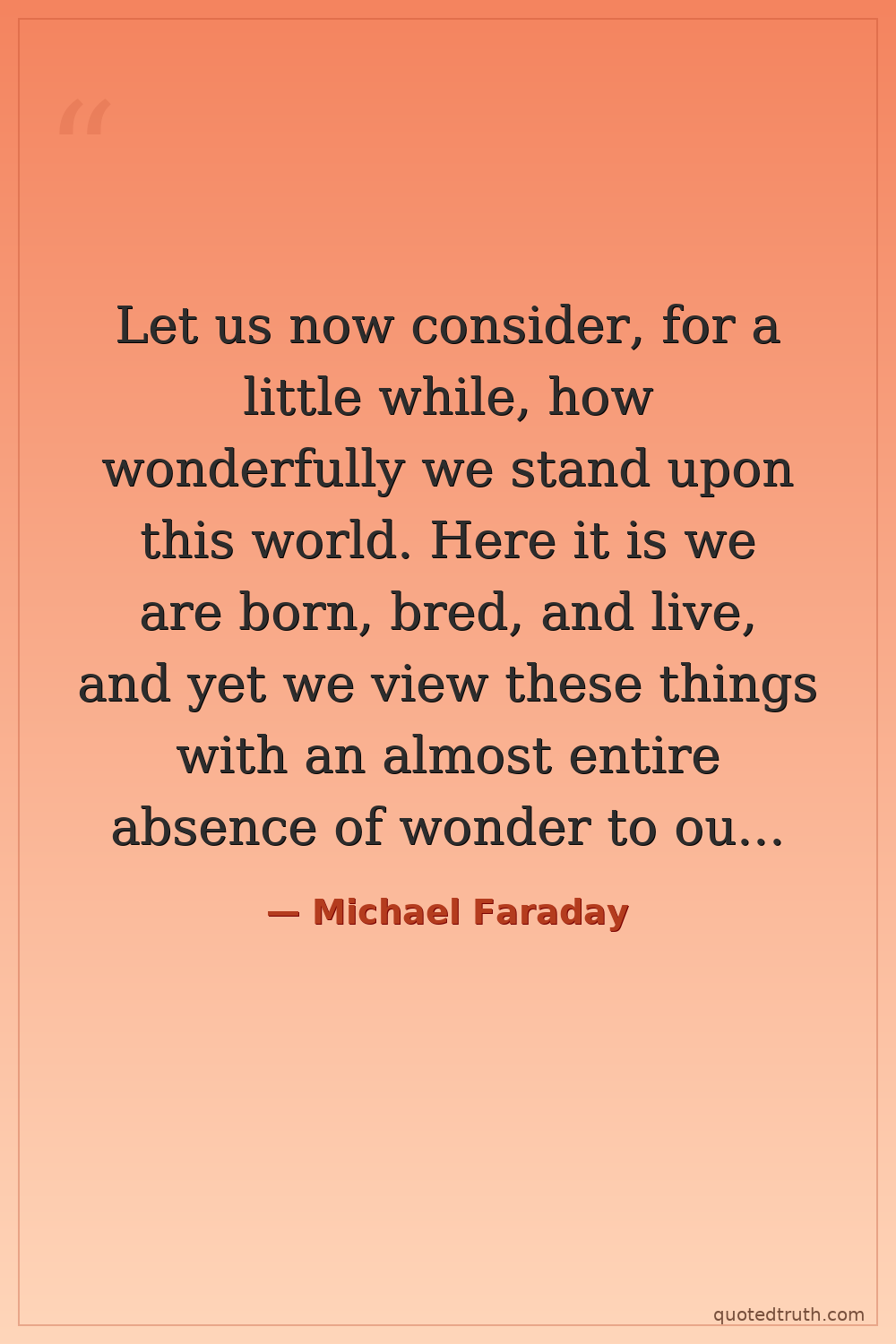
Faraday urges readers to pause and marvel at the sheer strangeness of existence. We are born into this world, grow up, and live our entire lives here, yet we take the whole arrangement for granted. Familiarity has dulled our capacity for amazement so thoroughly that nothing surprises us anymore. He is calling for a deliberate recovery of wonder toward ordinary reality, treating the everyday as the genuine mystery it actually is.
Relevance to Michael Faraday
Faraday built his career on refusing to accept the ordinary as ordinary. A self-taught bookbinder's apprentice who became the era's greatest experimentalist, he extracted electromagnetic induction, the motor principle, and field theory from phenomena others walked past. His famous Christmas Lectures at the Royal Institution turned candles and iron filings into revelations. As a devout Sandemanian, he also viewed nature's intricacy as evidence of a Creator deserving reverent attention.
The era
Faraday spoke during the early-to-mid 1800s, when the Industrial Revolution was normalizing steam engines, gas lighting, and telegraph wires at dizzying speed. Victorian Britain prized empirical science yet risked treating new marvels as mere utilities. Public science lectures were mass entertainment, and Faraday's Royal Institution talks drew crowds hungry for meaning alongside mechanism. His plea against jadedness pushed back on an age where rapid technological familiarity was already eroding the public's sense of awe.
AI-generated insights based on extensive research and information for context. Factual errors? Email [email protected].