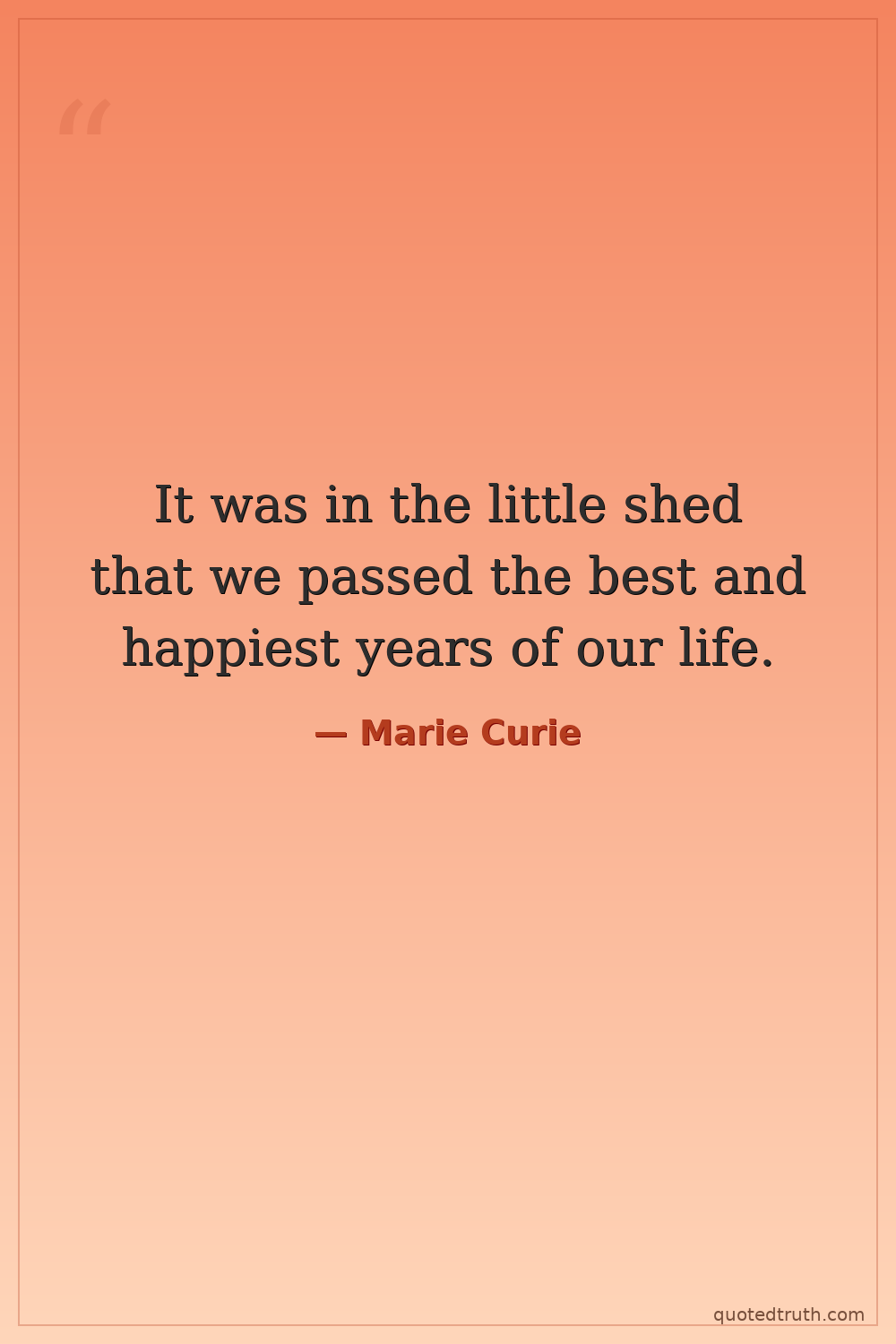
Marie Curie — "It was in the little shed that we passed the best and happiest years of our life…"
It was in the little shed that we passed the best and happiest years of our life.
It was in the little shed that we passed the best and happiest years of our life.
Click any product to generate a realistic preview. Up to 3 at a time.
* Initial load can take up to 90 seconds — revising the preview in another color is nearly instant.
"I did not come to France to make money. I came to France to study science."
"I am a woman of science. I am a woman of reason. I am a woman of logic. I am a woman of truth. I am a woman of justice. I am a woman of peace. I am a woman of love. I am a woman of humanity. I am all …"
"I am a dreamer. I am a scientist. I am a woman. I am a human being. I am all of these things. And I am proud of it."
"I am among those who think that science has great beauty. A scientist in his laboratory is not merely a technician: he is also a child confronting natural phenomena that impress him as though they wer…"
"A scientist must be a child. He must be curious. He must be eager to learn. He must be willing to make mistakes."
Referring to their laboratory, from her autobiography 'Madame Curie'
Date: 1937 (posthumous publication)
GeneralFound in 1 providers: grok
1 source checked
Curie is saying that the most fulfilling period of her life was not spent in comfort or acclaim, but in a humble workshop doing the work she loved alongside someone she loved. Joy came from shared purpose and immersive labor, not from wealth, recognition, or ease. The modest setting mattered less than the meaningful effort and partnership happening inside it.
Marie and Pierre Curie processed tons of pitchblende in a leaky, unheated shed at the School of Physics in Paris, isolating radium under brutal conditions. Despite later Nobel fame, she remembered those grueling years fondly because of the discovery, the partnership, and the purpose. It captures her ascetic devotion to science, her indifference to status or comfort, and her deep bond with Pierre before his 1906 death.
In late 1890s and early 1900s Paris, women were largely excluded from serious scientific institutions, and funding for unproven research was scarce. The Curies worked without proper lab space, safety knowledge, or pay while radioactivity was a brand-new field. Europe was entering an era of explosive scientific progress, yet a married woman doing pioneering chemistry in a shed was radical, reflecting how frontier science was often improvised on the margins.
AI-generated insights based on extensive research and information for context. Factual errors? Email [email protected].
Your cart is empty