What it means
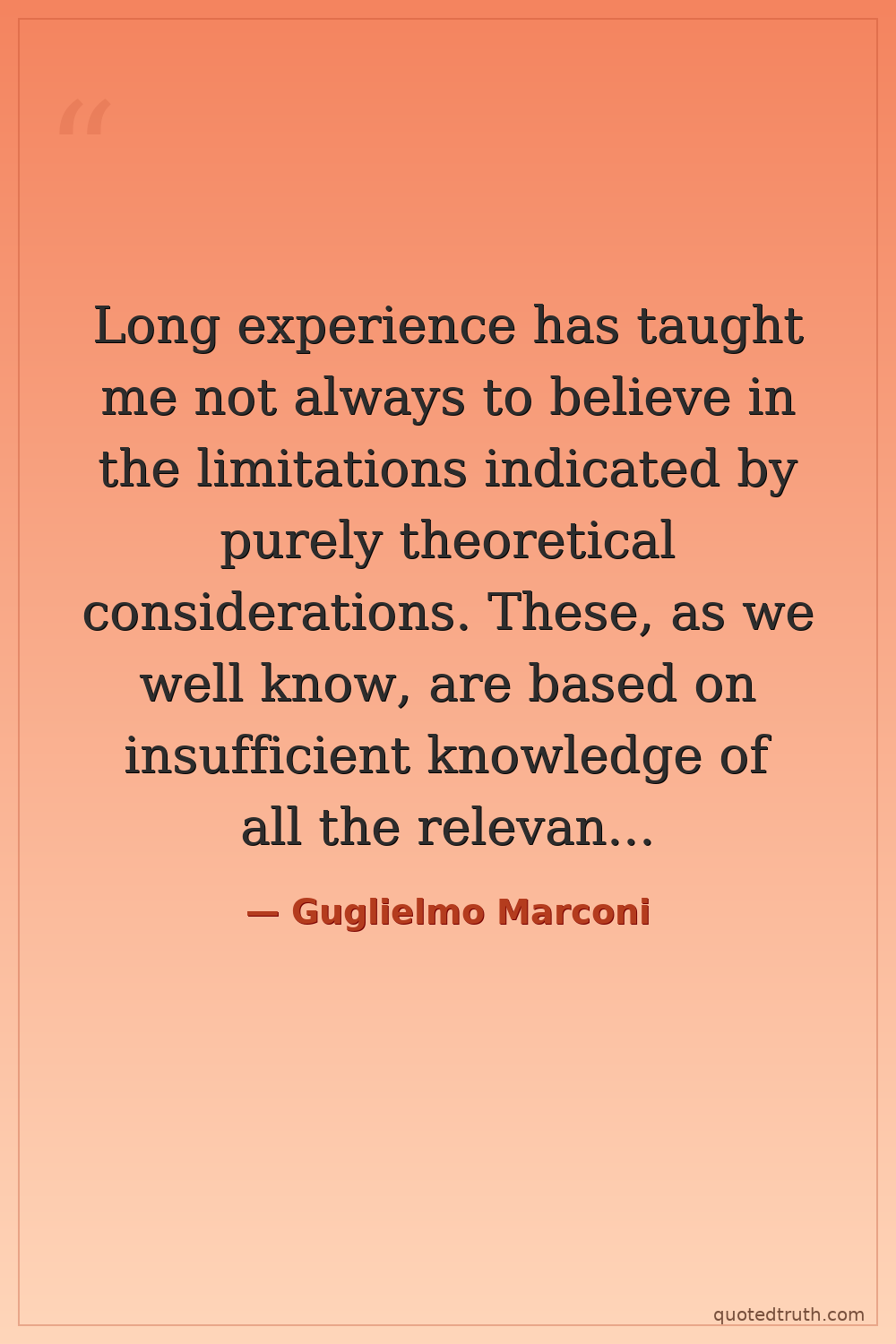
Theory tells us what should be impossible — but real-world experience regularly defies those limits. Marconi argues that theoretical barriers are only as reliable as the knowledge behind them, which is never complete. Practical experimentation reveals factors no equation yet accounts for. Rather than accepting intellectual constraints as final, he urges trusting accumulated hands-on experience, which can expose the gaps that pure reasoning misses.
Relevance to Guglielmo Marconi
When Marconi proposed transatlantic radio transmission, physicists insisted it was theoretically impossible — radio waves travel in straight lines and Earth's surface curves away. They were wrong. In 1901, he successfully sent a signal from Cornwall to Newfoundland, later explained by the ionosphere, then unknown. An entrepreneur-inventor rather than a pure theorist, Marconi built his career on testing ideas experts dismissed, making skepticism of theoretical limits personally and professionally foundational.
The era
The late 19th and early 20th centuries were a golden age of invention but also of theoretical authority. Figures like Lord Kelvin issued confident pronouncements about what technology could never achieve, and Maxwell's equations were treated as the final word on electromagnetism. Yet within decades, quantum mechanics, relativity, and the ionosphere overturned established limits. Marconi's era proved repeatedly that theoretical consensus could be demolished by a single well-designed experiment.
AI-generated insights based on extensive research and information for context. Factual errors? Email [email protected].