What it means
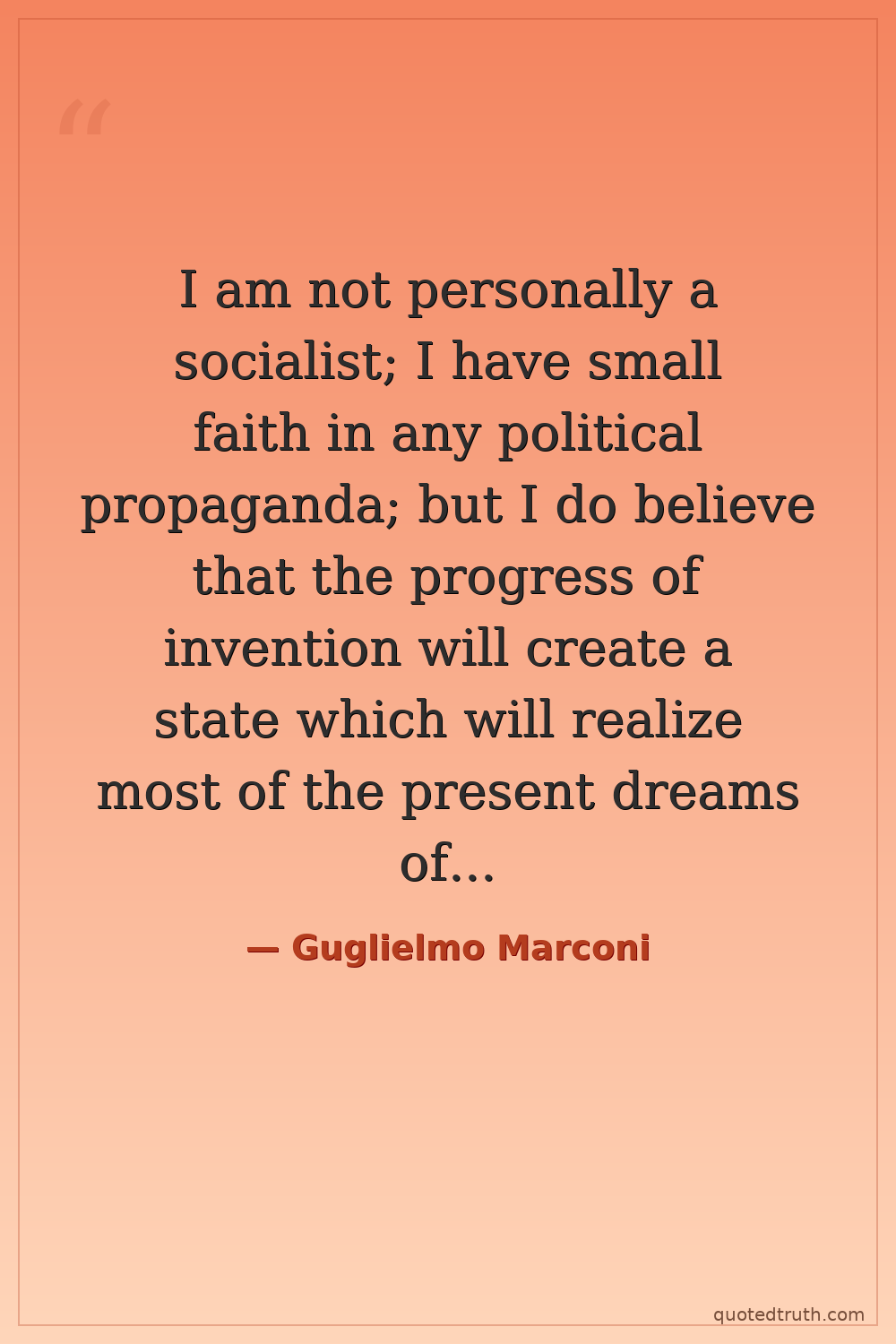
Marconi argues that technological invention — not political movements — will deliver the practical outcomes socialists seek: broader equality, improved living conditions, and shared access to prosperity. He rejects socialism as a political program while validating its underlying goals. His point is that inventors, not propagandists, will reshape society by creating tools and systems that organically distribute opportunity and reduce the material deprivations that fuel radical politics.
Relevance to Guglielmo Marconi
Marconi's invention of wireless radio directly democratized communication, breaking the monopoly of costly undersea cables controlled by wealthy interests. He saw firsthand how technology could bridge class divides — ships at sea, remote communities, and ordinary people gained access to information previously reserved for elites. His engineering career embodied his belief: practical invention, not political agitation, was the reliable path to the social improvements others sought through ideology.
The era
Marconi was active during the turbulent late 19th and early 20th centuries, when industrial capitalism created extreme wealth gaps and socialist movements surged across Europe. The Russian Revolution of 1917 and labor uprisings defined the era. Simultaneously, electricity, radio, and the automobile were genuinely transforming daily life for ordinary people. Techno-optimism competed directly with political radicalism as rival answers to inequality, making Marconi's confidence in invention especially resonant.
AI-generated insights based on extensive research and information for context. Factual errors? Email [email protected].