What it means
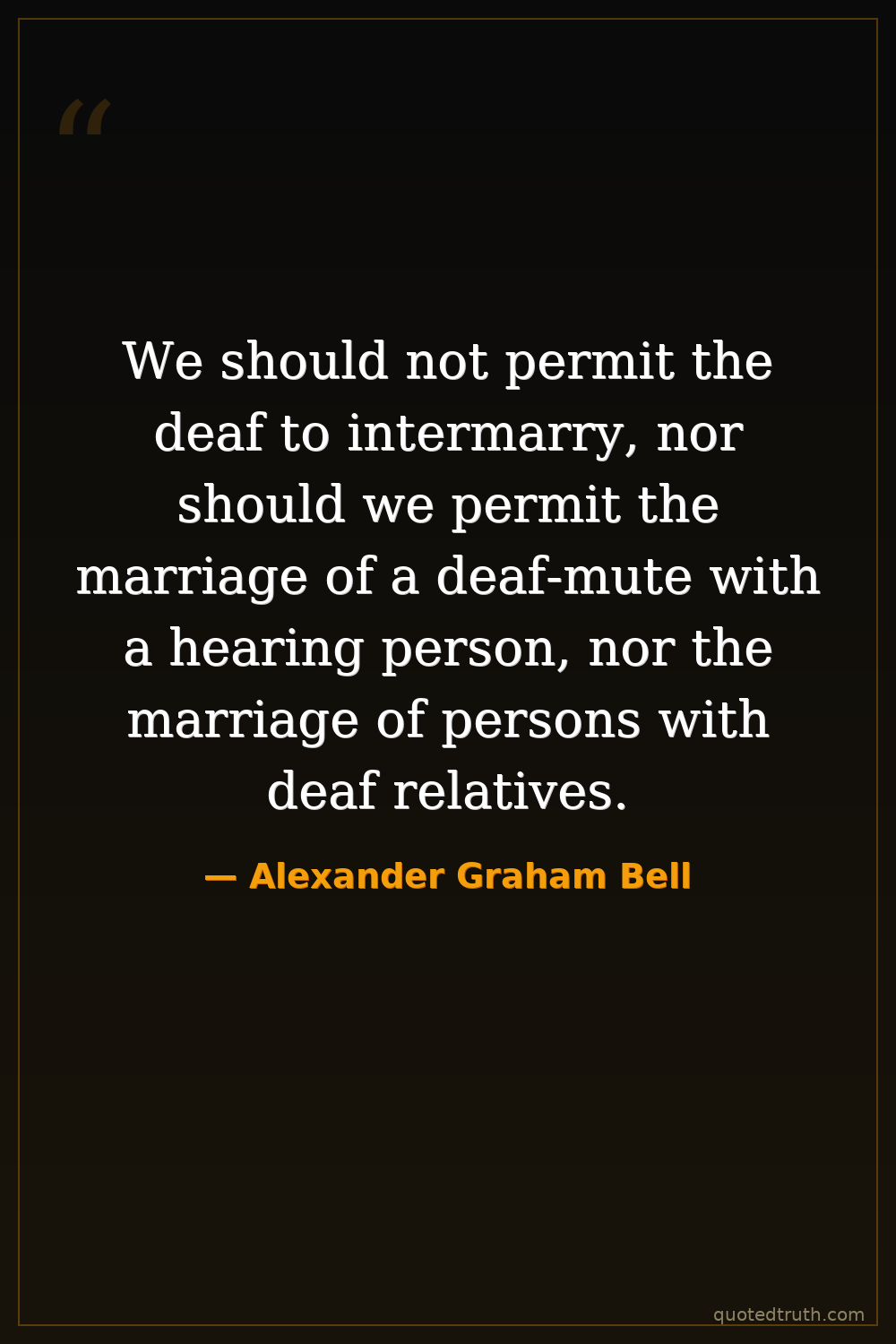
This quote advocates prohibiting deaf people from marrying one another, marrying hearing people, or allowing anyone with deaf relatives to marry — essentially calling for reproductive control over the deaf community. The goal was to prevent hereditary deafness from persisting across generations, treating deafness as a defect to be eliminated from the human population through enforced social and legal restrictions on who could legally wed.
Relevance to Alexander Graham Bell
Bell's mother and wife Mabel Hubbard were both deaf, yet he became eugenics' most prominent advocate against hereditary deafness. In 1883 he published 'Memoir Upon the Formation of a Deaf Variety of the Human Race,' warning that deaf schools fostered closed communities perpetuating deafness. He lobbied Congress to restrict deaf intermarriage, revealing a profound contradiction: deep personal ties to the deaf community alongside determined efforts to eliminate deafness genetically.
The era
Bell wrote this during the 1880s–1900s, when Francis Galton's eugenics movement was gaining scientific legitimacy and Social Darwinism framed hereditary defects as threats to societal progress. The American eugenics movement was nascent but accelerating — within decades it would produce forced sterilization laws in over 30 states. Bell's invention fame lent credibility to these arguments, making his anti-intermarriage campaign particularly damaging to deaf culture, identity, and community cohesion.
AI-generated insights based on extensive research and information for context. Factual errors? Email [email protected].