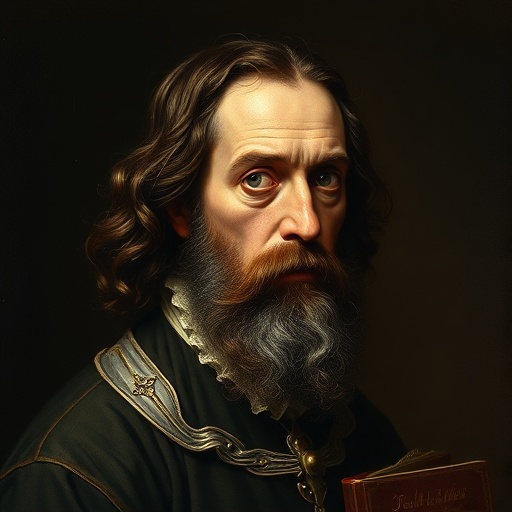
Johannes Kepler — "I have found the truth, and it is beautiful."
I have found the truth, and it is beautiful.
I have found the truth, and it is beautiful.
Click any product to generate a realistic preview. Up to 3 at a time.
* Initial load can take up to 90 seconds — revising the preview in another color is nearly instant.
"The Earth too wants to have a soul, and the sky wants to rule over it."
"The celestial machine is not like a divine animal but like a clockwork."
"I have often been in danger, but God has always protected me."
"Some of what these pamphlets [of astrological forecasts] say will turn out to be true, but most of it time and experience will expose as empty and worthless. The latter part will be forgotten [literal…"
"I much prefer the sharpest criticism of a single intelligent man to the thoughtless approval of the masses."
Found in 1 providers: grok
1 source checked
The speaker declares they have discovered something true and found it deeply beautiful. Truth, in their view, is not dry or cold but aesthetically pleasing, even awe-inspiring. Finding it produces joy and wonder, not merely satisfaction. The statement fuses intellectual discovery with emotional and artistic response, suggesting that genuine understanding of reality carries its own elegance, and that rigorous inquiry can culminate in something the discoverer experiences as sublime.
Kepler spent decades hunting mathematical order in planetary orbits, eventually replacing circles with ellipses and uncovering his three laws of planetary motion. A devout Lutheran, he saw the cosmos as God's geometry and described celestial harmony in musical terms in Harmonices Mundi. For him, truth about the heavens was literally beautiful, uniting mathematics, theology, and aesthetics. His painstaking work on Tycho Brahe's Mars data embodies this quote's marriage of discovery and wonder.
Kepler lived 1571 to 1630, during the early Scientific Revolution and amid the Thirty Years' War and fierce Counter-Reformation tensions. Copernican heliocentrism was still radical and dangerous; Galileo faced the Inquisition in Kepler's lifetime. Mathematics was beginning to displace Aristotelian philosophy as the language of nature. Renaissance Neoplatonism encouraged seeing divine beauty in geometric order, making Kepler's fusion of empirical rigor, mystical harmony, and aesthetic delight characteristic of this transitional early modern moment.
AI-generated insights based on extensive research and information for context. Factual errors? Email [email protected].
Your cart is empty