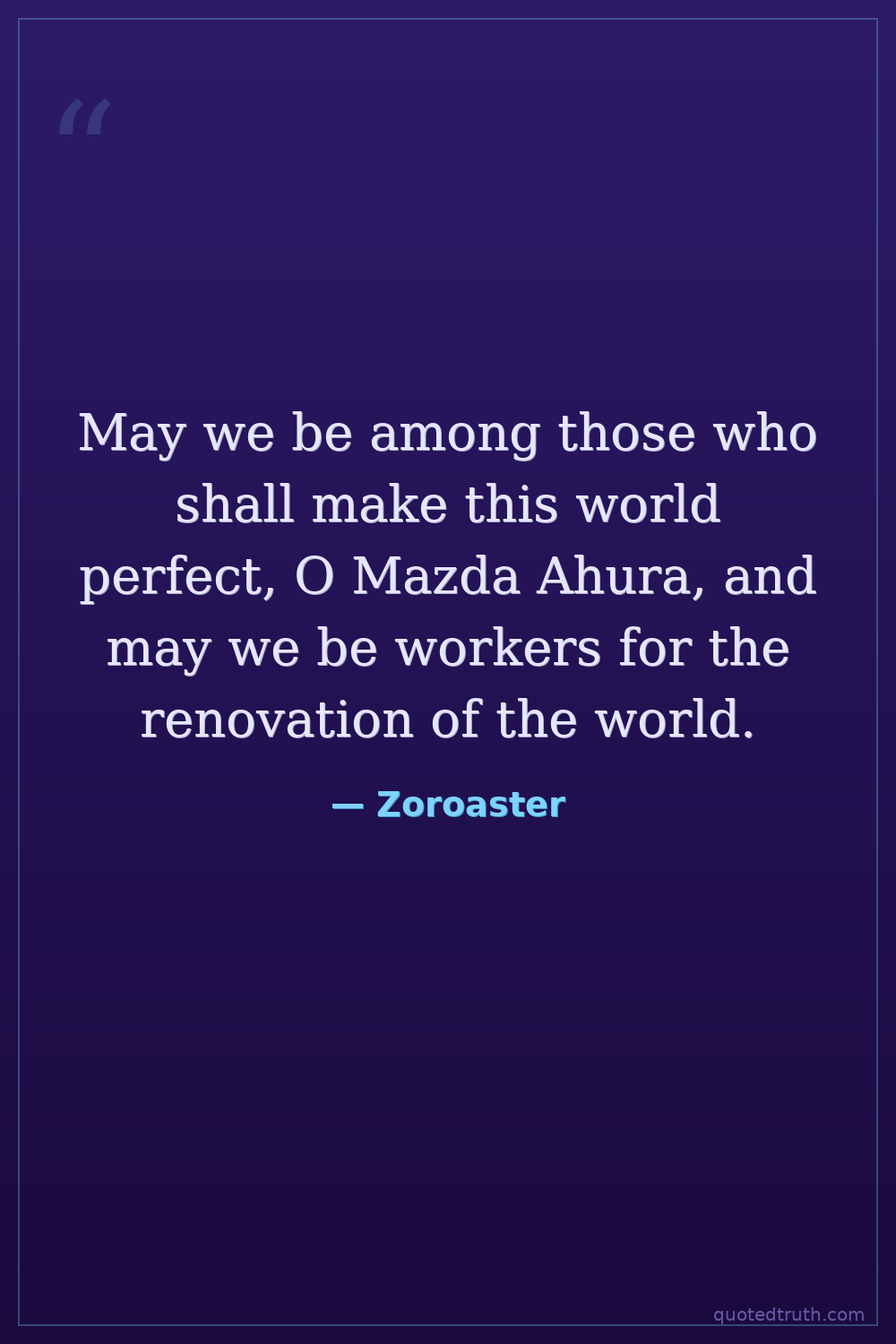
Zoroaster — "May we be among those who shall make this world perfect, O Mazda Ahura, and may …"
May we be among those who shall make this world perfect, O Mazda Ahura, and may we be workers for the renovation of the world.
May we be among those who shall make this world perfect, O Mazda Ahura, and may we be workers for the renovation of the world.
Click any product to generate a realistic preview. Up to 3 at a time.
* Initial load can take up to 90 seconds — revising the preview in another color is nearly instant.
"Embrace change. Unless it involves getting up early on a weekend."
"The liar is the greatest enemy of mankind."
"I declare the truth to all who will listen."
"The path to enlightenment is long. And sometimes, you need a snack break."
"I seek to know from Thee, O Mazda, what is the reward of the one who brings forth good for the world, and what is the punishment of the one who brings forth evil?"
Iranian prophet who founded Zoroastrianism, the first major religion of cosmic dualism between good (Ahura Mazda) and evil (Angra Mainyu). Closely associated with The Buddha (near-contemporary Eastern moral-cosmological revolutionary). For an intellectual contrast, see Friedrich Nietzsche, German philosopher of 'beyond good and evil' — Nietzsche appropriated Zarathustra's name for Thus Spoke Zarathustra (1883) precisely to invert the original's moral cosmology — the historical Zoroaster founded the good-versus-evil framework Nietzsche's character announces the end of.
Found in 1 providers: gemini
1 source checked
This is a prayer asking to be counted among the people actively working to improve and ultimately perfect the world. The speaker addresses the supreme god, expressing a desire to participate in the great cosmic project of renewing creation, fixing what is broken, and bringing the world closer to its ideal state through deliberate, ongoing effort rather than passive waiting.
Zoroaster taught Frashokereti, the doctrine that humans are partners with Ahura Mazda in restoring the world to perfection. As a religious reformer who broke from older Iranian polytheism, he framed ethical action, truthful speech, and good deeds as direct contributions to defeating evil. This prayer captures the heart of his message: salvation is collective labor, not individual escape, and every righteous person is a co-renovator of existence.
Zoroaster preached in ancient Persia, likely between 1500 and 1000 BCE, when surrounding cultures emphasized appeasing capricious gods through sacrifice. His message reframed religion as moral struggle between truth and the lie, giving ordinary herders and farmers cosmic significance. The era saw tribal warfare, cattle raiding, and shifting Indo-Iranian societies, making his vision of a peaceful, restored world both radical and desperately needed by listeners enduring constant instability.
AI-generated insights based on extensive research and information for context. Factual errors? Email [email protected].
Your cart is empty