Louis Pasteur — "Messieurs, c'est les microbes qui auront le dernier mot. (Gentlemen, it is the m…"
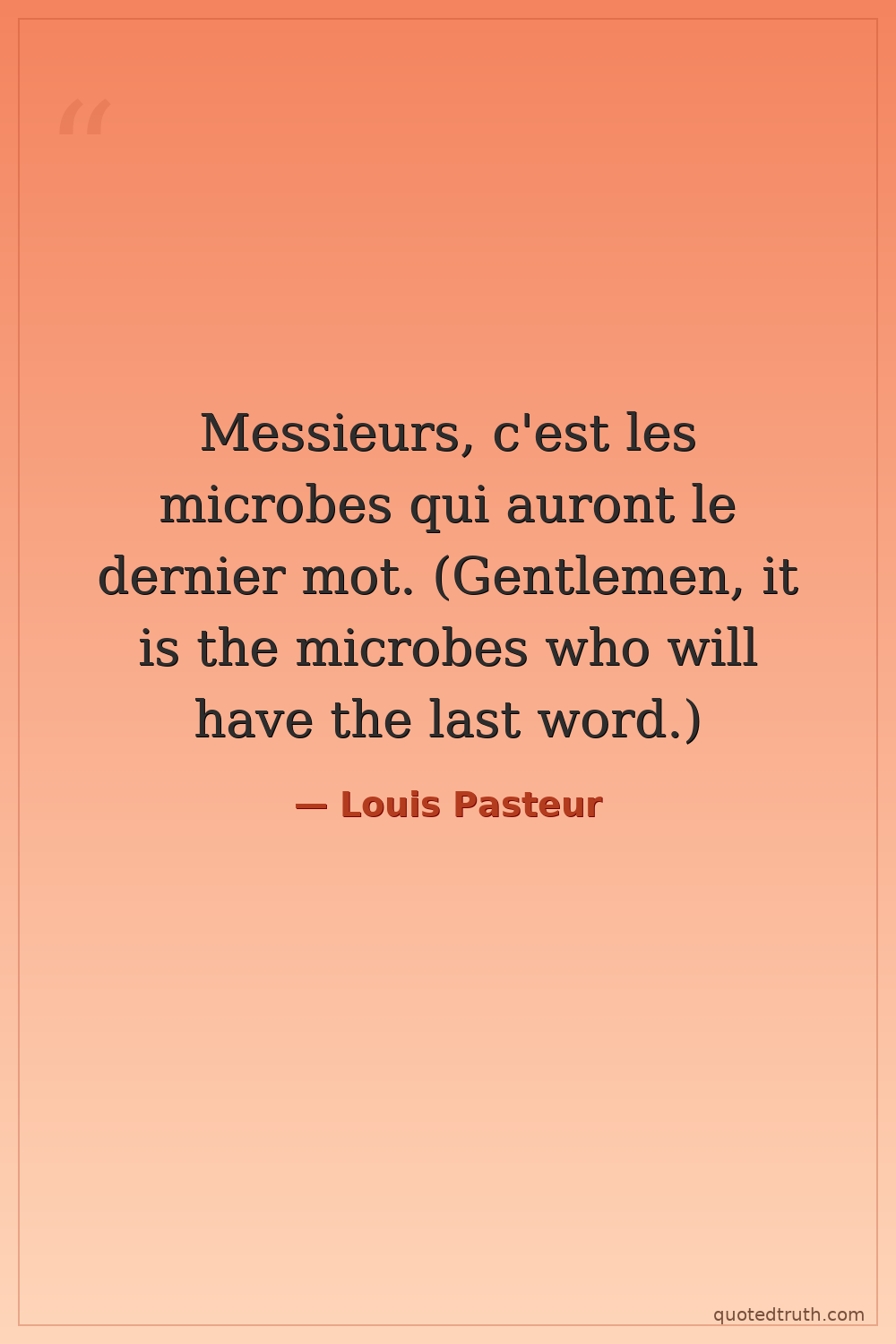
Messieurs, c'est les microbes qui auront le dernier mot. (Gentlemen, it is the microbes who will have the last word.)
Messieurs, c'est les microbes qui auront le dernier mot. (Gentlemen, it is the microbes who will have the last word.)
Click any product to generate a realistic preview. Up to 3 at a time.
* Initial load can take up to 90 seconds — revising the preview in another color is nearly instant.
"One must make sure that one has good tools, and then one must use them well."
"The greatest victory is that over oneself."
"The study of nature is always a source of profound joy."
"There are no such things as applied sciences, only applications of science."
"The Greeks understood the mysterious power of the hidden side of things."
A stark, almost darkly humorous, statement about the ultimate power of microbes.
Date: Late 19th century (approximate)
GeneralFound in 1 providers: gemini
1 source checked
Pasteur warns that no matter how clever or powerful humans become, microscopic organisms will ultimately determine outcomes in health, disease, and even decay after death. Tiny invisible life forms shape epidemics, food spoilage, and survival in ways people underestimate. He is saying we should respect these organisms because they will outlast us, decide who gets sick, and quietly govern the natural world long after human arguments end.
Pasteur built his career proving that invisible microbes caused disease, fermentation, and spoilage, overturning spontaneous generation. He developed pasteurization, vaccines for anthrax and rabies, and championed sterile technique. This quote distills his lifelong conviction that microorganisms, not human ingenuity, drive biological reality. Spoken near the end of his life, it reflects the humility of a scientist who spent decades watching microbes defeat physicians, farmers, and brewers until people finally accepted their existence.
In late 19th-century France, germ theory was still contested. Surgeons resisted handwashing, hospitals were death traps from puerperal fever, and cholera and tuberculosis killed millions. Industrial brewing, silk farming, and livestock were collapsing from unexplained microbial diseases. Pasteur's era saw the birth of microbiology, vaccination, and antiseptic surgery alongside fierce opposition from established medicine. His warning landed during a moment when humanity was just beginning to grasp that an unseen biological world fundamentally controlled health, food, and survival.
AI-generated insights based on extensive research and information for context. Factual errors? Email [email protected].
Your cart is empty