What it means
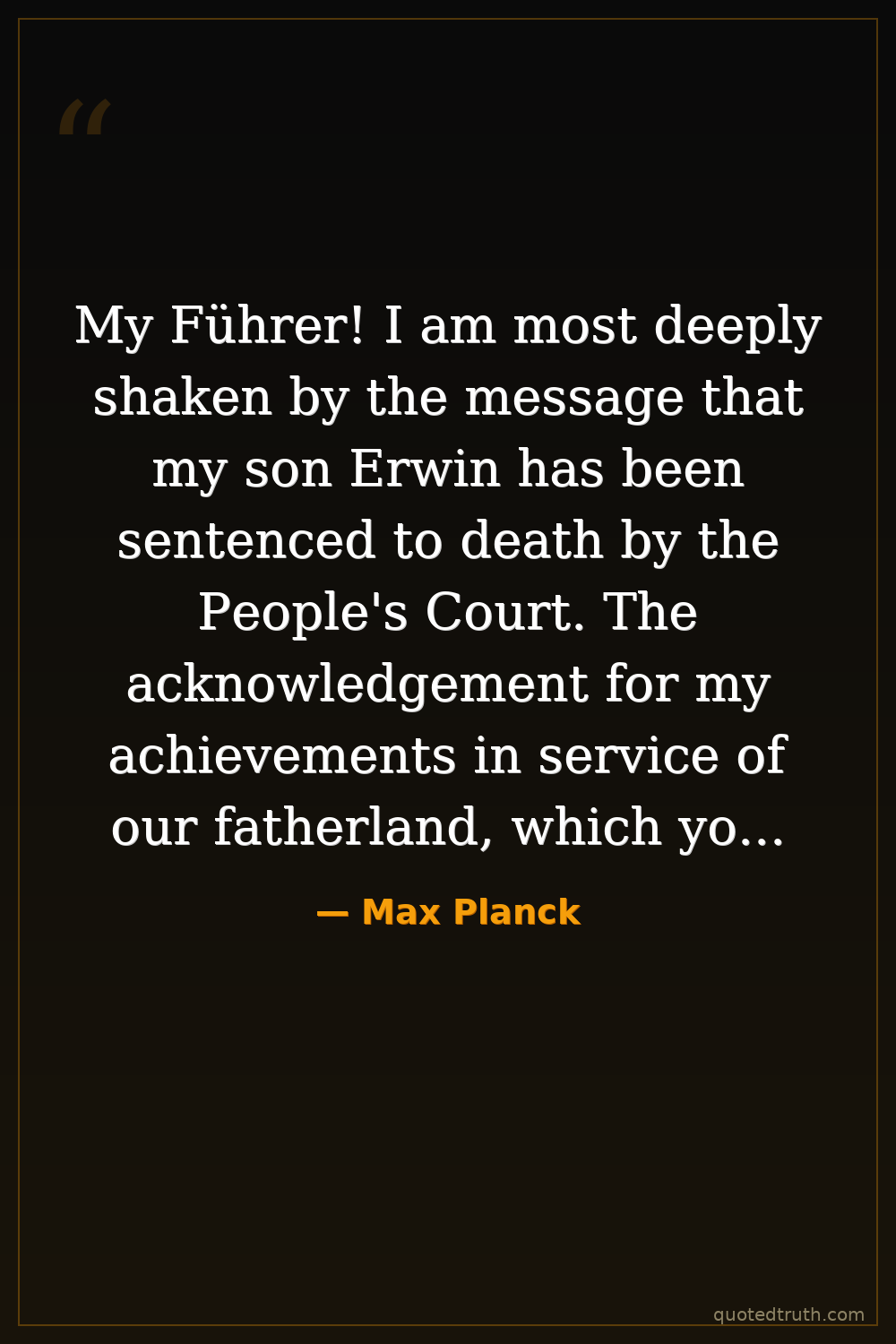
An elderly father begs a dictator to spare his son's life. He invokes his own lifetime of service and the honors he has received, hoping that gratitude for his contributions will buy mercy. The plea is desperate and formal, appealing not to justice but to personal recognition. It captures a parent willing to set aside pride and principle, bargaining a legacy built over decades for one chance to save his child from execution.
Relevance to Max Planck
Planck wrote this in 1944 to Hitler after his son Erwin was condemned for involvement in the July 20 plot to assassinate the Führer. Despite founding quantum theory and winning the 1918 Nobel Prize, Planck's scientific standing could not save Erwin, who was executed in January 1945. Planck had already lost his first son in WWI and two daughters in childbirth, making this a devastating final family tragedy for Germany's most celebrated physicist.
The era
Nazi Germany was collapsing in late 1944 as Allied forces advanced. After the failed July 20, 1944 assassination attempt on Hitler, the People's Court under Roland Freisler conducted show trials executing thousands of conspirators and suspected sympathizers. Prominent Germans who had remained in the country, like Planck, navigated a regime that demanded loyalty while destroying their families. The letter exemplifies how even Nobel laureates held no protection against Hitler's vengeance during the Reich's final violent months.
AI-generated insights based on extensive research and information for context. Factual errors? Email [email protected].