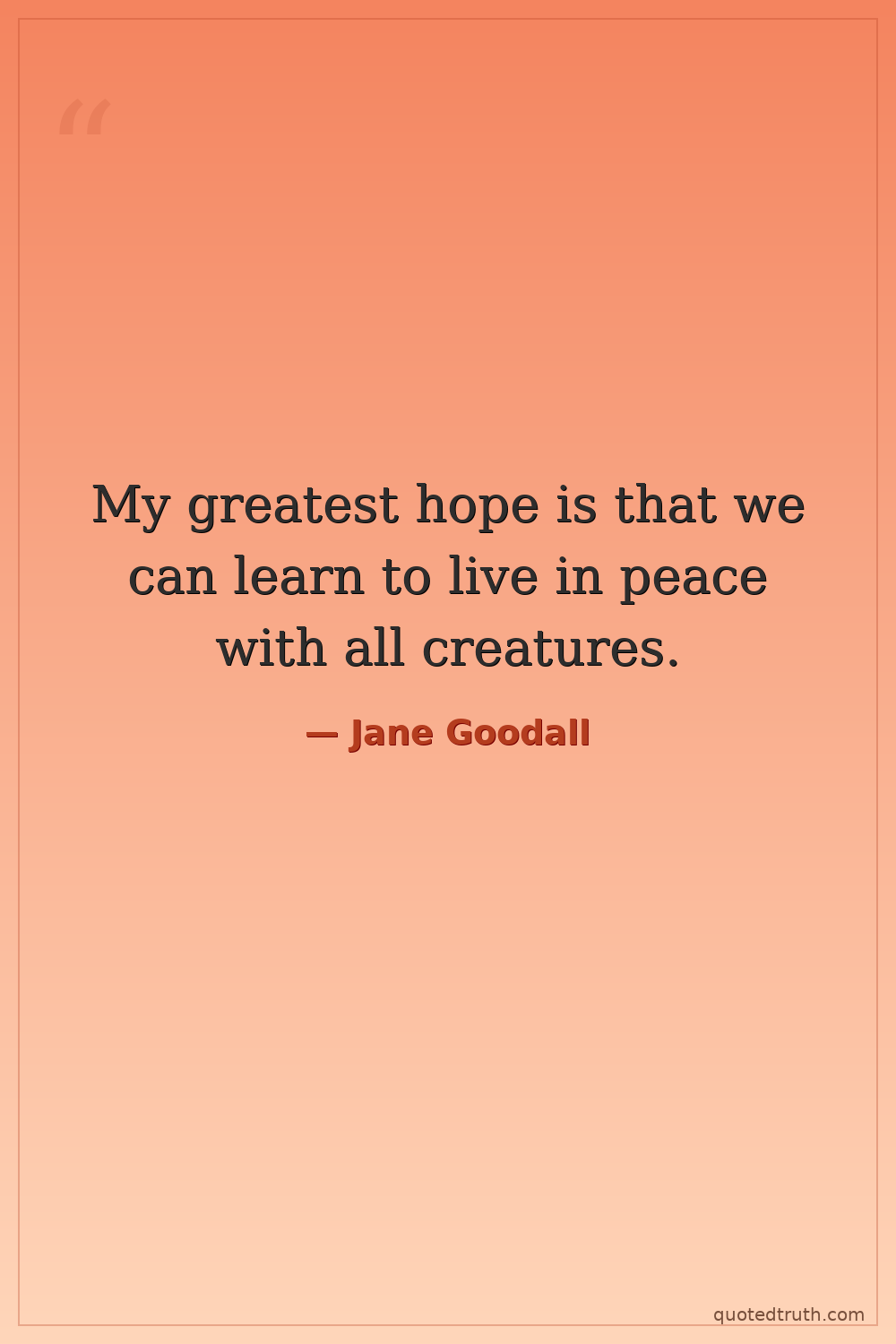
Jane Goodall — "My greatest hope is that we can learn to live in peace with all creatures."
My greatest hope is that we can learn to live in peace with all creatures.
My greatest hope is that we can learn to live in peace with all creatures.
Click any product to generate a realistic preview. Up to 3 at a time.
* Initial load can take up to 90 seconds — revising the preview in another color is nearly instant.
"We have to find a way to live in harmony with nature, or we will destroy ourselves."
"If we don't save the planet, we don't save ourselves."
"I'm not a pessimist. I'm a realist who believes in the power of hope."
"I don't understand why people are so afraid of nature. It's where we come from."
"The greatest gift we can give our children is a healthy planet."
British primatologist who in 1960 began the longest-running wild primate study at Gombe Stream, transforming our understanding of chimpanzees. Closely associated with Dian Fossey (mountain-gorilla researcher) and Birutė Galdikas (orangutan researcher; together with Goodall and Fossey one of Louis Leakey's 'Trimates'). For an intellectual contrast, see Walter Palmer, American dentist who killed Cecil the Lion in Zimbabwe in 2015 — Palmer represents the trophy-hunting tradition Goodall's life's work has been organized against — the colonial-era hunter-naturalist worldview that treated primates and big game as specimens or trophies, which Goodall's Roots & Shoots and Jane Goodall Institute exist specifically to displace.
Found in 1 providers: grok
1 source checked
The quote expresses a desire for humanity to stop treating other species as resources to exploit or obstacles to eliminate. It calls for genuine coexistence — recognizing that animals have inherent worth and that our survival is tied to theirs. It pushes back against a worldview where human progress comes at the expense of wildlife, asking instead that we extend the same respect we claim for ourselves to every living creature.
Goodall spent decades living among chimpanzees in Gombe, Tanzania, discovering they make tools, form complex social bonds, and experience emotions — proving humans aren't uniquely separate from the animal world. That revelation reshaped her into a fierce conservationist. She founded the Jane Goodall Institute, launched the Roots and Shoots youth program, and has spent the second half of her life traveling the globe advocating for wildlife, habitat protection, and ending the illegal bushmeat and exotic pet trades.
Goodall's career unfolded through the late 20th and early 21st centuries — a period marked by mass extinction rates, rampant deforestation, climate change debates, and the collapse of biodiversity. Industrial agriculture, urban expansion, and the illegal wildlife trade have driven thousands of species toward extinction. Her message carries urgency because the window for coexistence is closing: scientists now warn we are in a sixth mass extinction, entirely driven by human activity.
AI-generated insights based on extensive research and information for context. Factual errors? Email [email protected].
Your cart is empty