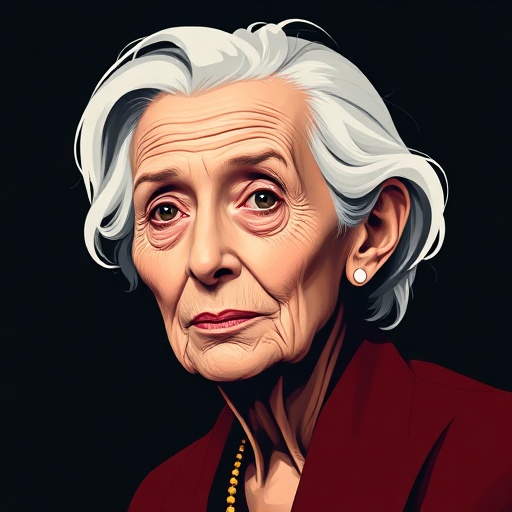
Jane Goodall — "I don't understand why people are so afraid of nature. It's where we come from."
I don't understand why people are so afraid of nature. It's where we come from.
I don't understand why people are so afraid of nature. It's where we come from.
Click any product to generate a realistic preview. Up to 3 at a time.
* Initial load can take up to 90 seconds — revising the preview in another color is nearly instant.
"We need to inspire hope in young people, and empower them to create a better future."
"We must never give up hope."
"The future depends on what we do in the present."
"If we don't save the planet, we don't save ourselves."
"The more we learn of the true nature of non-human animals, especially those with complex brains and corresponding complex social behavior, the more ethical concerns are raised regarding their use in t…"
British primatologist who in 1960 began the longest-running wild primate study at Gombe Stream, transforming our understanding of chimpanzees. Closely associated with Dian Fossey (mountain-gorilla researcher) and Birutė Galdikas (orangutan researcher; together with Goodall and Fossey one of Louis Leakey's 'Trimates'). For an intellectual contrast, see Walter Palmer, American dentist who killed Cecil the Lion in Zimbabwe in 2015 — Palmer represents the trophy-hunting tradition Goodall's life's work has been organized against — the colonial-era hunter-naturalist worldview that treated primates and big game as specimens or trophies, which Goodall's Roots & Shoots and Jane Goodall Institute exist specifically to displace.
Found in 1 providers: grok
1 source checked
Humans have grown disconnected from the natural world, developing fear toward wildlife, wilderness, and untamed environments. Yet we evolved in nature — it is our biological origin, not an alien threat. This challenges that modern anxiety as irrational: you don't fear where you come from. The estrangement is cultural and recent, not innate, and reconnecting with nature is a return to something fundamental rather than a confrontation with something dangerous.
Goodall spent decades living among wild chimpanzees in Gombe, Tanzania, starting in 1960, immersing herself in forest rather than observing from a distance. She earned the trust of chimps like David Greybeard and demonstrated that humans and animals share emotional and behavioral bonds. As a lifelong conservationist who chose wilderness over laboratory, she embodied fearlessness toward nature and spent decades urging the world to see animals as kin, not threats.
Goodall's career spans the late 20th and early 21st centuries — a period of rapid urbanization, accelerating biodiversity loss, and deforestation. By the 1990s and 2000s, most people in developed nations lived in cities with little contact with wild animals. Richard Louv's nature deficit disorder concept emerged in 2005. As screens replaced outdoor time and wildlife became something seen on television, Goodall's observation captured a real cultural shift: nature had become foreign to the very species it produced.
AI-generated insights based on extensive research and information for context. Factual errors? Email [email protected].
Your cart is empty