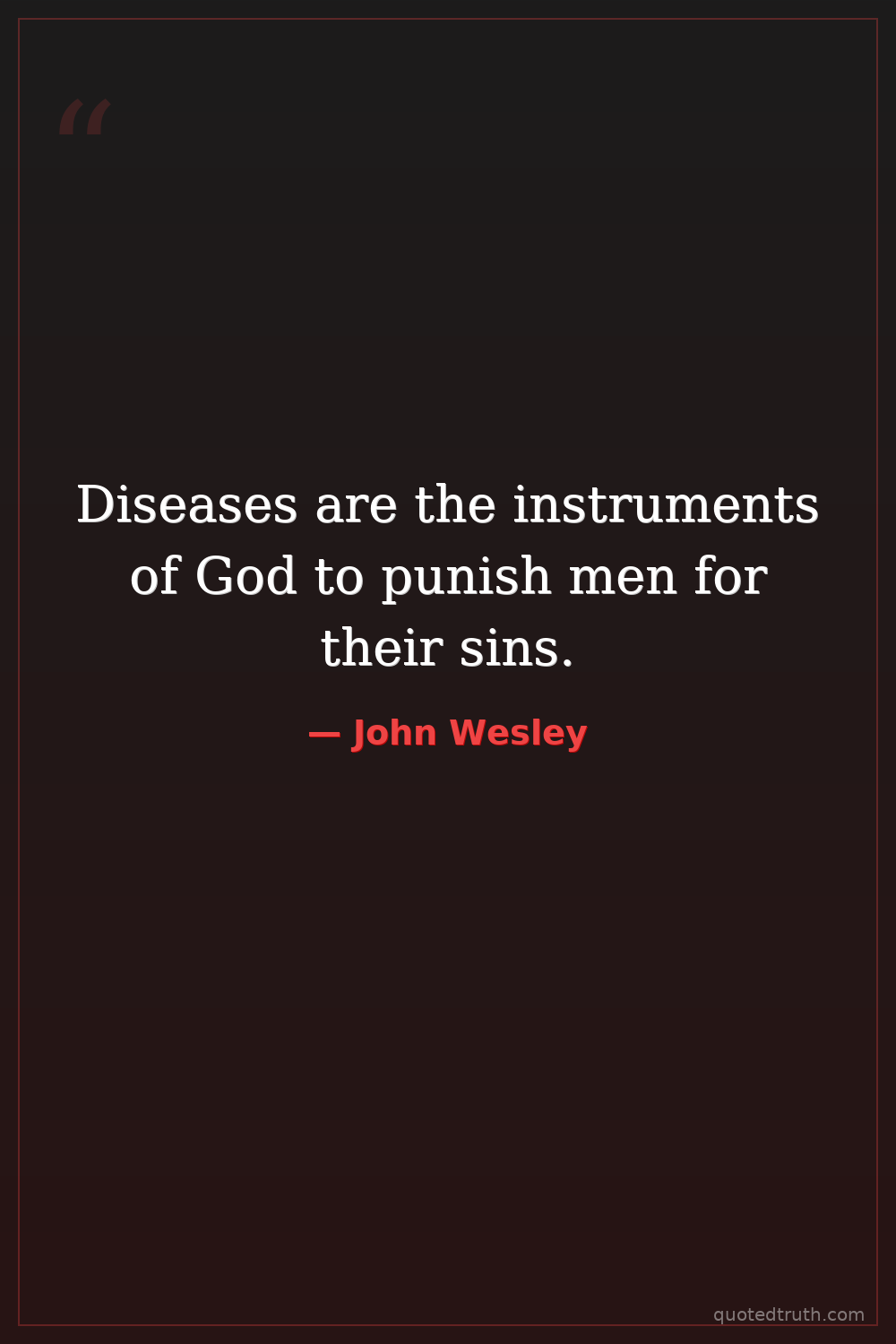
John Wesley — "Diseases are the instruments of God to punish men for their sins."
Diseases are the instruments of God to punish men for their sins.
Diseases are the instruments of God to punish men for their sins.
Click any product to generate a realistic preview. Up to 3 at a time.
* Initial load can take up to 90 seconds — revising the preview in another color is nearly instant.
"I should be glad if I could spend my whole life in reading and writing."
"Do all the good you can, by all the means you can, in all the ways you can, in all the places you can, at all the times you can, to all the people you can, as long as ever you can."
"Beware you be not swallowed up in books! An ounce of love is worth a pound of knowledge."
"I desire no other epitaph, than 'Here lies the friend of all, and the enemy of none.'"
"I have not lost a day since I was born."
English Anglican cleric and founder of Methodism, whose open-air preaching and class-meeting structure created the largest 18th-century evangelical revival. Closely associated with Charles Wesley (his hymn-writing brother) and George Whitefield (early co-revivalist, later doctrinal opponent). For an intellectual contrast, see George Whitefield, Calvinist evangelical revivalist — Whitefield's predestinarian Calvinism vs Wesley's free-grace Arminian theology split the early Methodist movement permanently in the 1739-41 break. The founding evangelical Calvinist-Arminian schism — the two parallel evangelical traditions American Christianity descends from.
Found in 1 providers: deepseek
1 source checked
This quote expresses a traditional theological belief that illness is not random misfortune but God's deliberate punishment for sin. Suffering carries moral causation — the body pays for spiritual failure. It claims sickness functions as divine accountability, a corrective or punitive response to wrongdoing. It denies chance in human suffering, instead attributing disease to God's active, judgmental intervention in human moral life.
Wesley authored 'Primitive Physick,' a medical handbook for the poor, revealing his conviction that physical and spiritual health were inseparable. As Methodism's founder, he preached rigorous personal holiness — sin had tangible consequences. He believed God governed every detail of life, including bodily affliction. His circuit-riding ministry served the sick, yet he simultaneously saw illness as evidence of humanity's fallen state requiring repentance.
In 18th-century England, germ theory didn't exist — disease causation was attributed to divine will, moral failure, or miasma. Smallpox, typhus, and cholera devastated populations regularly. Wesley lived through the Great Awakening and Methodist Revival, movements emphasizing God's active providence and personal accountability for sin. Theologians routinely interpreted epidemics as divine judgment, a framework rooted in biblical tradition and unchallenged until Pasteur's discoveries a century later.
AI-generated insights based on extensive research and information for context. Factual errors? Email [email protected].
Your cart is empty