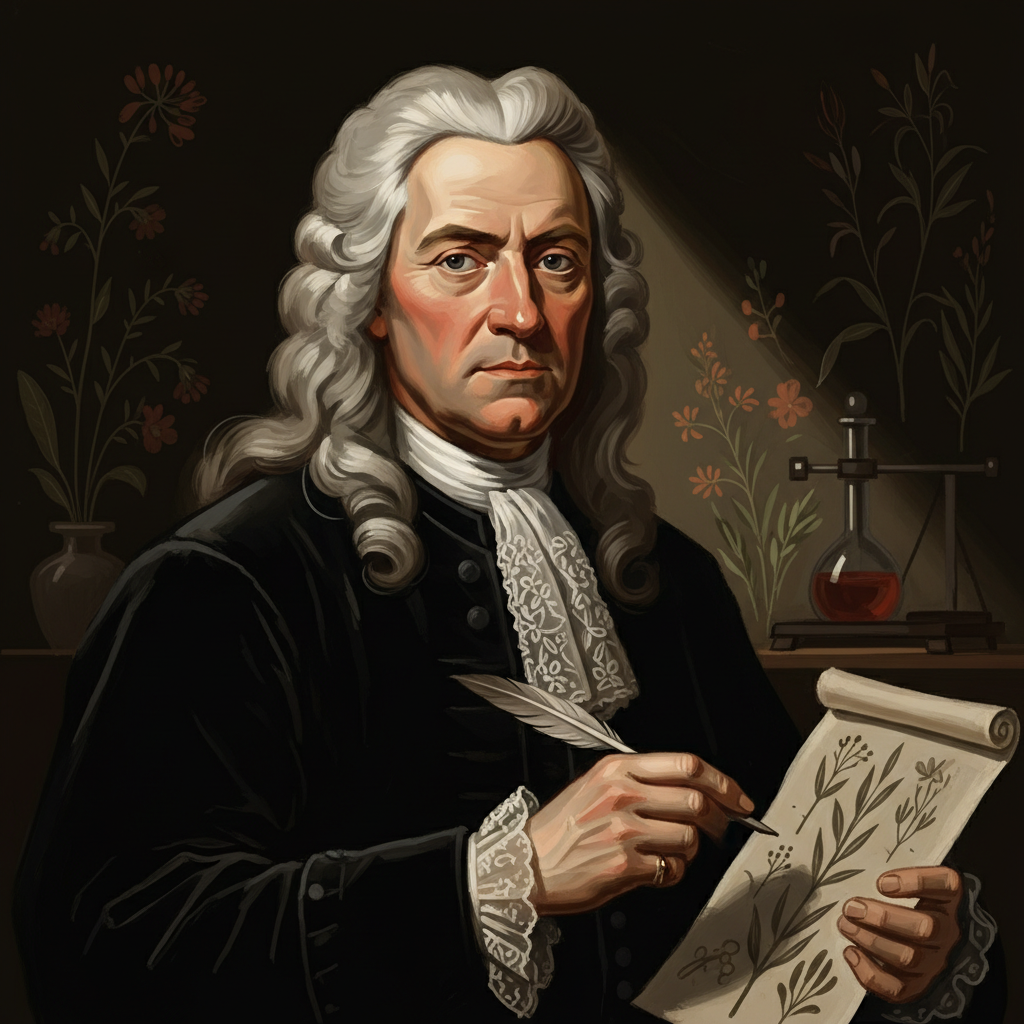
Carl Linnaeus — "My life has been dedicated to the service of nature."
My life has been dedicated to the service of nature.
My life has been dedicated to the service of nature.
Click any product to generate a realistic preview. Up to 3 at a time.
* Initial load can take up to 90 seconds — revising the preview in another color is nearly instant.
"I have seen the face of God."
"God created, Linnaeus arranged. It is astonishing how many new species are discovered every day."
"It is not God, but people themselves who shorten their lives by not keeping physically fit."
"A natural arrangement is one which is based on all parts of the plant."
"Blessed be the Lord for the beauty of summer and spring, for the air, the water, the verdure, and the song of birds."
Swedish botanist and the father of modern taxonomy whose Systema Naturae (1735) introduced binomial nomenclature for naming all species. Closely associated with Joseph Banks (British naturalist who carried Linnaean classification on Cook's voyages). For an intellectual contrast, see Comte de Buffon, French naturalist and Histoire Naturelle author (1749-1788) — Buffon explicitly attacked Linnaean fixed-categories taxonomy as artificial and rejected the binomial system; his gradualist, environment-shaped natural history was the explicit alternative. Anticipates the fixed-species-vs-evolution debate Darwin would later resolve.
Found in 1 providers: grok
1 source checked
The speaker committed their entire existence to understanding, documenting, and honoring the natural world rather than pursuing wealth, power, or social ambition. Every hour, every journey, every observation served nature's study. It expresses total devotion — a life measured not by personal gain but by contribution to knowledge of living things around us.
Linnaeus literally organized all known life, creating binomial nomenclature still used today. He led botanical expeditions across Lapland and Europe, catalogued thousands of species, and built Uppsala's botanical garden. His Systema Naturae ran through twelve editions. Nature wasn't his career — it was his identity, his religion, his reason for existing.
The 18th-century Enlightenment drove Europeans to classify and rationalize everything, including the natural world. Colonial expansion brought floods of unknown specimens from Americas, Asia, and Africa. Naturalists competed to name and order creation. Linnaeus worked amid this explosion of discovery, when systematic science was replacing folklore and scripture as humanity's framework for understanding living things.
AI-generated insights based on extensive research and information for context. Factual errors? Email [email protected].
Your cart is empty