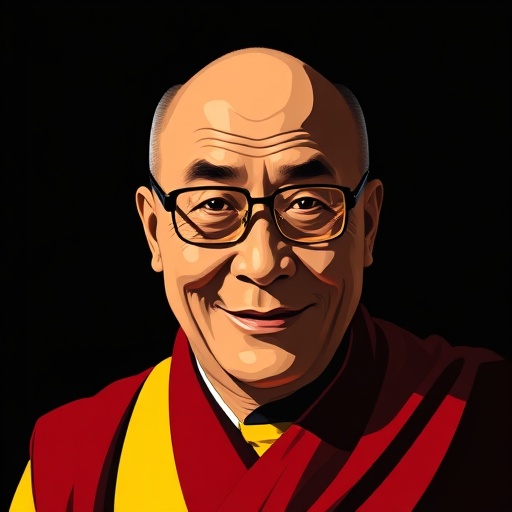
Dalai Lama (14th) — "My main concern is the well-being of the six million Tibetans."
My main concern is the well-being of the six million Tibetans.
My main concern is the well-being of the six million Tibetans.
Click any product to generate a realistic preview. Up to 3 at a time.
* Initial load can take up to 90 seconds — revising the preview in another color is nearly instant.
"I am just one human being. I am not special."
"I think I am a very good cook. My specialty is Tibetan food."
"If a new Dalai Lama comes, that female must be attractive. Otherwise, not much use."
"I believe that all human beings are fundamentally good. Sometimes they just get confused."
"I am a Marxist monk."
Found in 1 providers: grok
1 source checked
The statement prioritizes collective welfare over personal, political, or religious ambition. He is saying that protecting six million people—their lives, culture, and dignity—is his central purpose, not spiritual advancement or global fame. It is a declaration of duty: everything he does on the world stage, every speech, negotiation, and plea, exists in service of a specific, countable group of human beings whose survival remains under serious threat.
Tenzin Gyatso has lived in exile since China's 1959 military crackdown forced him from Lhasa. For over 65 years he has championed his Middle Way policy—seeking genuine autonomy, not independence—through diplomacy rather than violence. Nobel Peace Prize laureate in 1989, he relinquished formal political leadership in 2011 but retained moral authority. His concern for Tibetans is existential: without his advocacy, their cultural identity risks systematic erasure under Beijing's governance.
Tibet was annexed by China in 1950, and since 1959 has faced policies critics call cultural erasure: restrictions on Buddhist practice, monastery surveillance, Han resettlement programs, and bans on displaying the Dalai Lama's image. The 1989 Tiananmen crackdown amplified global scrutiny of Beijing's human rights record. As China's economic rise granted geopolitical leverage, the Tibetan cause became a defining test of whether international moral pressure could protect a small nation's cultural survival against a dominant state.
AI-generated insights based on extensive research and information for context. Factual errors? Email [email protected].
Your cart is empty