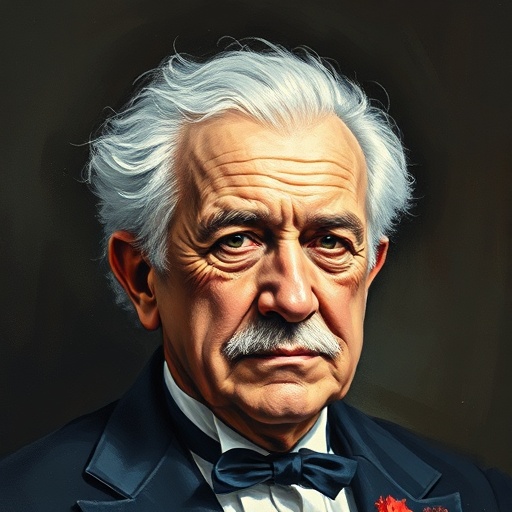
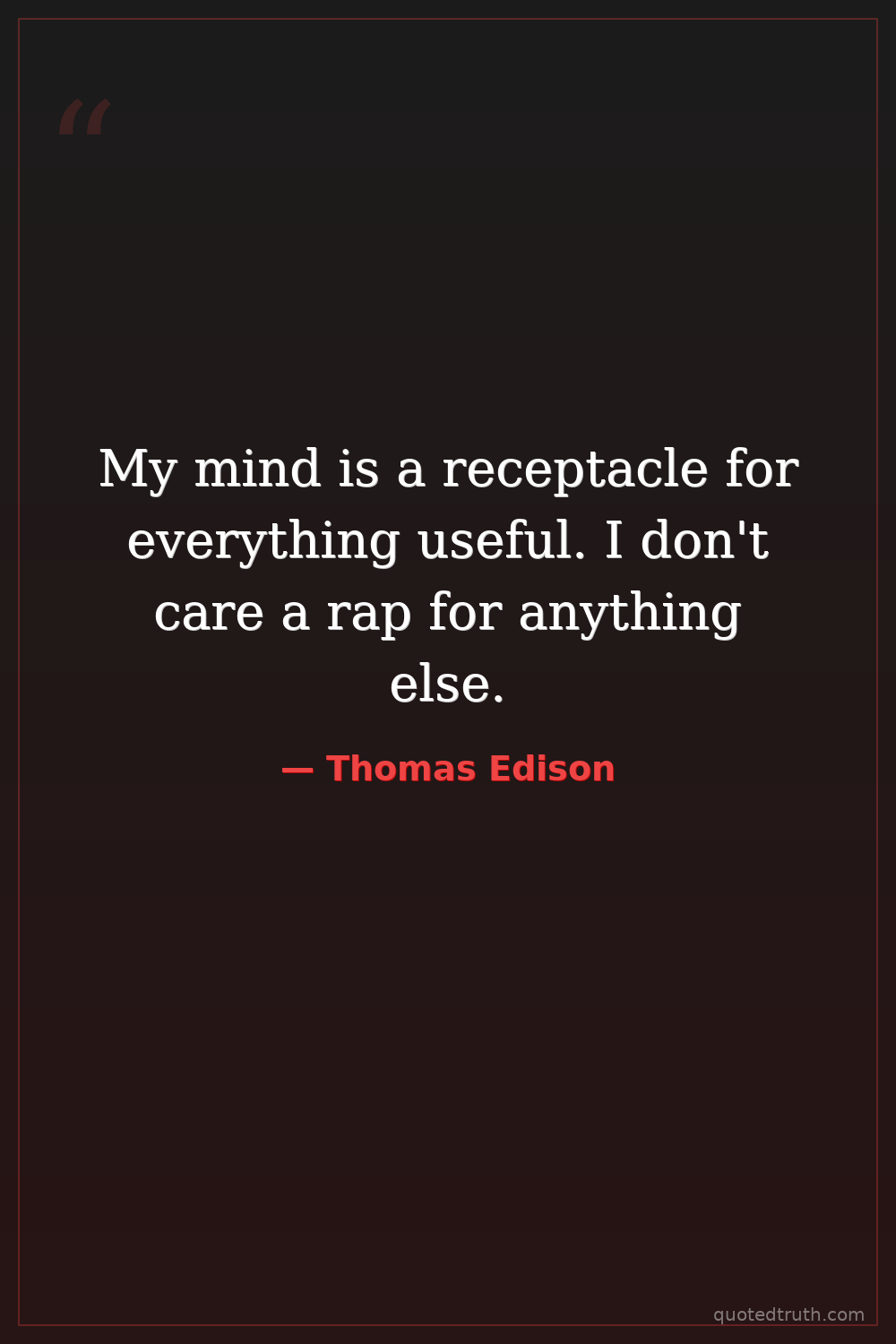
Thomas Edison — "My mind is a receptacle for everything useful. I don't care a rap for anything e…"
My mind is a receptacle for everything useful. I don't care a rap for anything else.
My mind is a receptacle for everything useful. I don't care a rap for anything else.
Click any product to generate a realistic preview. Up to 3 at a time.
* Initial load can take up to 90 seconds — revising the preview in another color is nearly instant.
"I am a good listener, but I also have a great deal of patience."
"The first thing is to find out what the world needs; then proceed to invent it."
"The chief function of the body is to carry the brain around."
"The world is full of people who are always waiting for someone else to do something about their problems."
"I am not a scientist. I am an inventor."
Found in 1 providers: grok
1 source checked
Edison declares his mind functions as a storage system reserved exclusively for practical, useful information — nothing more. He has zero interest in knowledge that can't be applied or built upon. It's a philosophy of ruthless intellectual filtering: trivia, decoration, and theory without application are actively rejected. Mental bandwidth is a finite resource, and he allocates every bit of it toward what can solve problems or create something real.
Edison held over 1,093 patents and ran the world's first industrial research laboratory at Menlo Park. His entire career was defined by applied invention, not theoretical science — he famously clashed with Tesla over practicality versus pure theory. He kept meticulous notebooks cataloguing every useful observation. This quote directly mirrors his documented method: voracious reading of technical literature, retaining only what could yield a product or solve a concrete engineering problem.
Edison worked during the Second Industrial Revolution, when America transformed from agrarian to industrial powerhouse. Capital flowed to inventors who produced sellable results, not abstract thinkers. The Gilded Age celebrated self-made men who converted ideas into commercial products. Pure science was barely funded; utility dominated everything. Edison's Menlo Park lab pioneered systematic, profit-driven invention, and his contempt for 'useless' knowledge mirrored the era's broader worship of productive output over intellectual ornament.
AI-generated insights based on extensive research and information for context. Factual errors? Email [email protected].
Your cart is empty