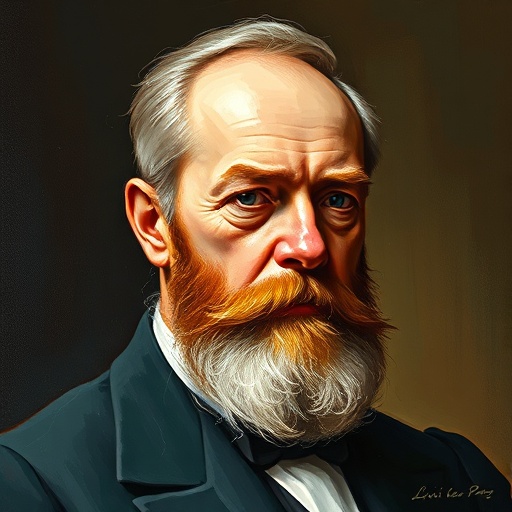
Louis Pasteur — "My passion for truth was the only guide of my life."
My passion for truth was the only guide of my life.
My passion for truth was the only guide of my life.
Click any product to generate a realistic preview. Up to 3 at a time.
* Initial load can take up to 90 seconds — revising the preview in another color is nearly instant.
"It is by observation and experimentation that we discover the laws of nature."
"When I approach a child, he inspires in me two sentiments: tenderness for what he is, and respect for what he may become."
"Do not let yourself be tainted with a barren skepticism."
"The greatest victory is that over oneself."
"I have been for the past three years studying a disease which is called hydrophobia, or rabies. It is a disease which I believe to be caused by a microbe."
Attributed, reflecting his lifelong commitment to scientific truth.
Date: Late 19th Century (approx.)
InspirationalFound in 1 providers: grok
1 source checked
The speaker declares that a relentless commitment to discovering what is actually true shaped every decision and direction in their life. Rather than chasing money, fame, approval, or convenience, they let honest evidence and intellectual integrity determine where to go next. Truth was not one value among many but the single compass, overriding personal comfort, popular opinion, or professional reward whenever the two came into conflict.
Pasteur's career embodied this claim. He rigorously disproved spontaneous generation, defended germ theory against entrenched medical opinion, and refined pasteurization through exhaustive experiments rather than shortcuts. A devout yet empirical thinker, he famously said science knows no country and refused honors from regimes he disagreed with. His willingness to challenge physicians, brewers, and silk farmers alike, guided purely by what experiments revealed, shows truth genuinely outranked reputation or consensus in his choices.
Pasteur worked in 19th-century France during a scientific revolution in chemistry, microbiology, and public health. Industries like wine, beer, and silk faced ruinous spoilage and disease, while hospitals lost patients to unexplained infections. Spontaneous generation was still accepted dogma, and vaccination beyond smallpox was unproven. Nationalism, religious tension, and academic gatekeeping pressured scientists to conform. Against this backdrop, a public pledge to follow evidence wherever it led was both professionally risky and culturally radical.
AI-generated insights based on extensive research and information for context. Factual errors? Email [email protected].
Your cart is empty