What it means
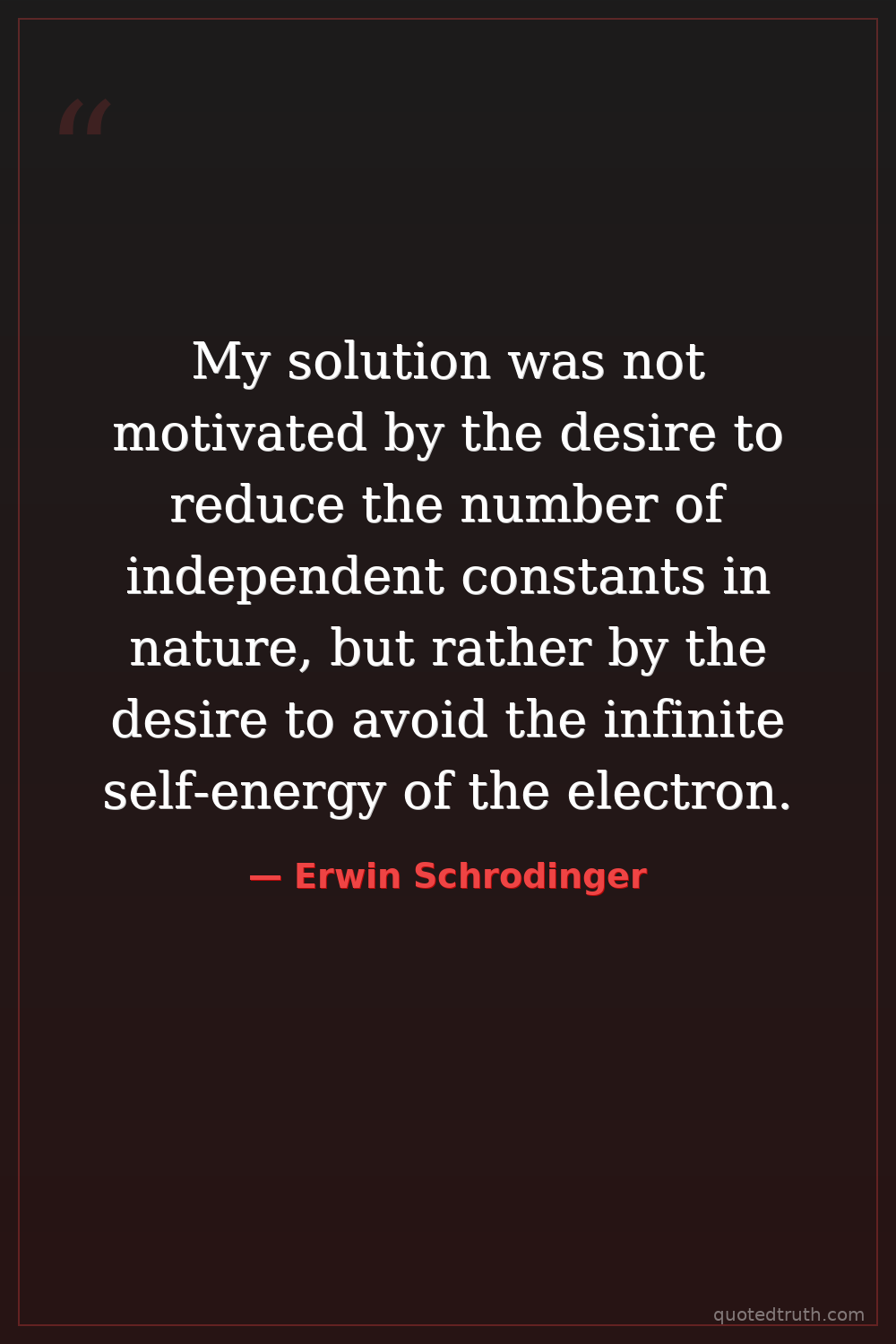
Schrödinger clarifies that his theoretical work wasn't driven by the desire for elegant simplification — reducing the number of independent physical constants that appear in nature, a goal many unifiers pursued. His real motivation was a concrete, pressing problem: classical physics treats the electron as a point particle, causing its self-generated electromagnetic energy to blow up to infinity. He wanted a formulation that sidestepped this mathematical catastrophe.
Relevance to Erwin Schrodinger
Schrödinger's 1926 wave equation replaced the classical point electron with a spread-out wave function — inherently dissolving the self-energy singularity by distributing the electron across space. He was renowned for physical intuition grounded in real problems rather than abstract elegance. His lifelong commitment to wave-based reality over particle discreteness reflects exactly what this quote states: physics should resolve genuine physical absurdities, not chase mathematical minimalism or unification for its own sake.
The era
In the 1920s, the electron's infinite self-energy was one of physics' deepest embarrassments — classical electrodynamics predicted that a point charge generates an infinite field energy at its own location, a result with no physical meaning. Renormalization techniques to handle such infinities wouldn't mature until QED in the 1940s. Simultaneously, Einstein's unified field theory program dominated headlines, making Schrödinger's pointed disclaimer — this wasn't about unification — a meaningful positioning within that charged theoretical landscape.
AI-generated insights based on extensive research and information for context. Factual errors? Email [email protected].