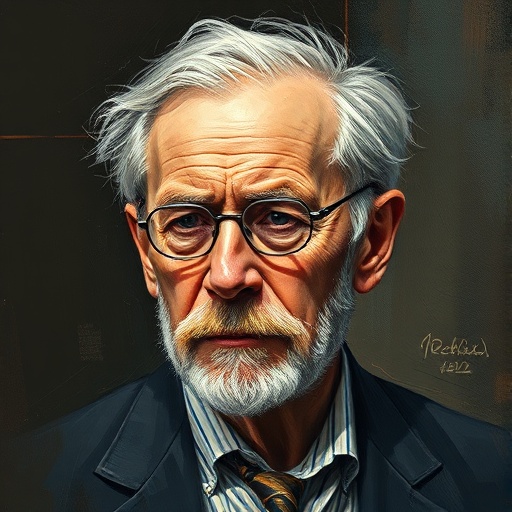
Erwin Schrodinger — "The future is uncertain, but that is precisely what makes it interesting."
The future is uncertain, but that is precisely what makes it interesting.
The future is uncertain, but that is precisely what makes it interesting.
Click any product to generate a realistic preview. Up to 3 at a time.
* Initial load can take up to 90 seconds — revising the preview in another color is nearly instant.
"We are thus faced with the following dilemma: either the organism is a purely statistical system, and then it is certainly not a quantum mechanical system, or it is a quantum mechanical system, and th…"
"We are thus faced with the following dilemma: either the cells of the organism contain a highly efficient 'memory' for all the details of previous events, or they are, in some mysterious way, able to …"
"The scientific method is the best way to get at the truth, but it is not the only way."
"The plurality that we perceive is only an appearance; it is not real. Vedantic philosophy... has sought to clarify it by a number of analogies."
"The meaning of life is to be found in the experience of living itself."
Austrian physicist who shared the 1933 Nobel for the wave equation that bears his name and the famous cat thought-experiment. Closely associated with Werner Heisenberg (matrix-mechanics rival who reached the same physics by different math) and Albert Einstein (his pen-pal on quantum interpretation). For an intellectual contrast, see Niels Bohr, Danish physicist and architect of the Copenhagen interpretation — Schrödinger's cat thought-experiment was specifically designed to ridicule Bohr's 'observer-dependent reality' reading of quantum mechanics — Schrödinger thought the Copenhagen interpretation was absurd; the cat was meant as reductio ad absurdum.
Found in 1 providers: grok
1 source checked
Uncertainty isn't a flaw or something to fear — it's the source of possibility and fascination. If outcomes were predetermined, there would be nothing to discover, strive for, or wonder about. Embracing the unknown keeps curiosity alive. Rather than seeking comfort in fixed answers, the statement argues that the open-endedness of what's to come is exactly what gives life and inquiry their vitality and forward momentum.
Schrödinger built his career on quantum uncertainty — his wave equation describes particles as probability distributions, not fixed trajectories. His famous thought experiment, Schrödinger's Cat, dramatized how a system exists in superposition until observed. He embraced indeterminacy as a fundamental truth about nature, not a gap in knowledge. Fleeing Nazi-occupied Austria and rebuilding his career in Dublin, he lived uncertainty personally and intellectually until his death in 1961.
Schrödinger worked during the quantum revolution of the 1920s–1950s, when physics was overturning centuries of Newtonian determinism. Heisenberg's uncertainty principle, Bohr's complementarity, and Einstein's relativity shattered the idea that the universe ran like clockwork. World War II further collapsed every political and existential certainty. In that climate of radical upheaval, reframing uncertainty as intellectually exciting rather than threatening was both a scientific stance and a psychological survival strategy.
AI-generated insights based on extensive research and information for context. Factual errors? Email [email protected].
Your cart is empty