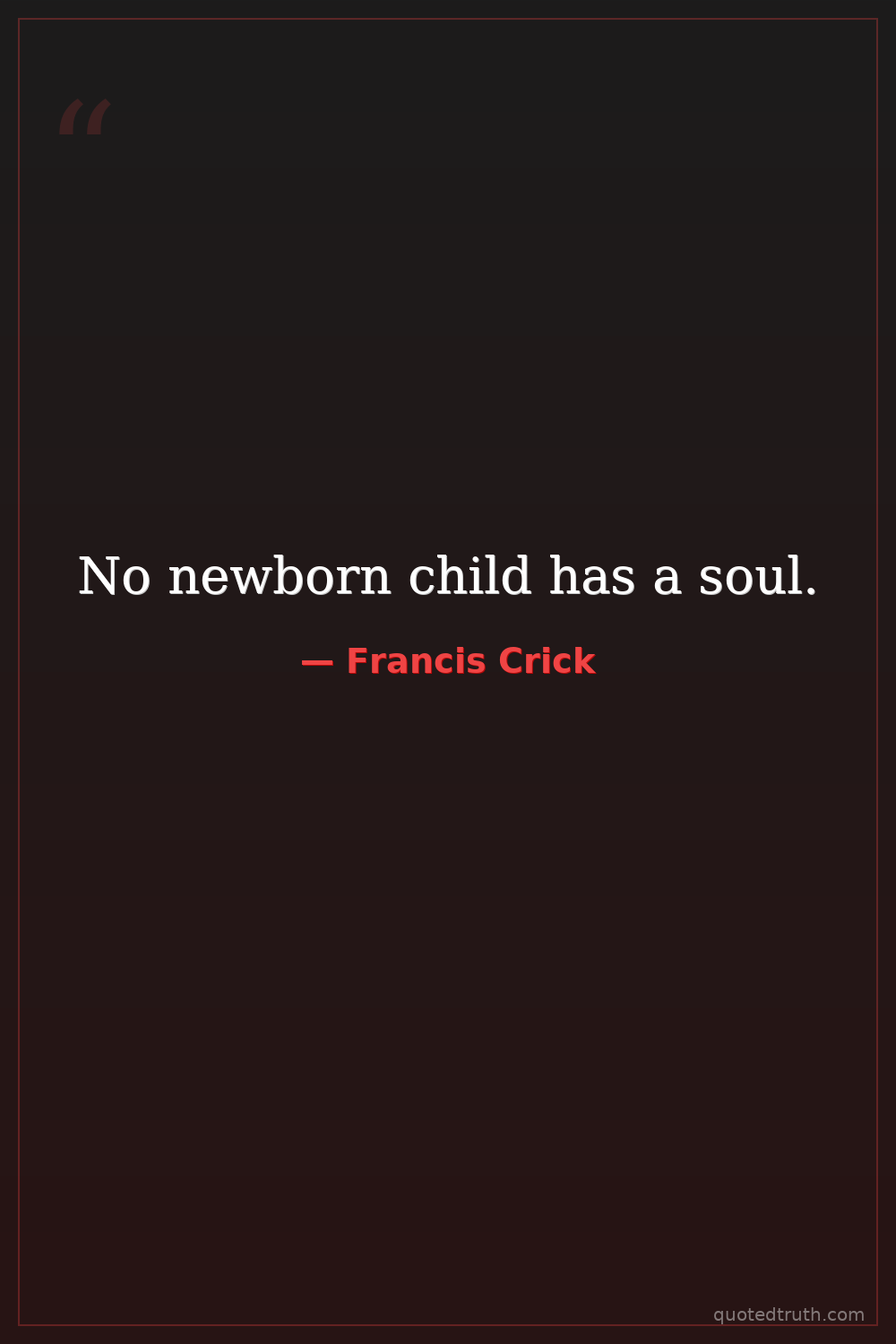
Francis Crick — "No newborn child has a soul."
No newborn child has a soul.
No newborn child has a soul.
Click any product to generate a realistic preview. Up to 3 at a time.
* Initial load can take up to 90 seconds — revising the preview in another color is nearly instant.
"If you are honest, you will find that you are often wrong. But if you are not honest, you will never find out."
"If you are not a little bit mad, you will never discover anything new."
"There is no ghost in the machine."
"I am an atheist, and I don't believe in God."
"The most important thing for me is to understand."
In his book 'The Astonishing Hypothesis: The Scientific Search for the Soul'
Date: 1994
ReligiousFound in 1 providers: deepseek
1 source checked
Consciousness, identity, and what people traditionally call a 'soul' are not present at birth but emerge gradually through brain development. Crick argues there is no immaterial essence — personhood is a biological process that unfolds over time. This reframes moral and ethical questions about infancy, abortion, and rights around neuroscience rather than theology or metaphysics, treating the mind as a product of physical matter rather than divine endowment.
After co-discovering DNA's structure in 1953, Crick spent his final decades at the Salk Institute studying the neural basis of consciousness — what he called 'the astonishing hypothesis.' A committed materialist and atheist, he believed all mental phenomena arise purely from physical brain processes. This quote directly expresses his lifelong rejection of vitalism and supernatural biology, extending his molecular-level view of life to its philosophical endpoint: no soul, only neurons.
Crick made this argument in the late 20th century, when neuroscience was rapidly mapping consciousness to specific neural correlates and the molecular biology revolution had stripped mysticism from genetics. Simultaneously, Western bioethics debates over abortion, IVF, and personhood were intensifying along religious-secular fault lines. His statement was deliberately provocative — a scientist using hard-won biological authority to challenge theological frameworks that still dominated legal and cultural definitions of human life and moral status.
AI-generated insights based on extensive research and information for context. Factual errors? Email [email protected].
Your cart is empty