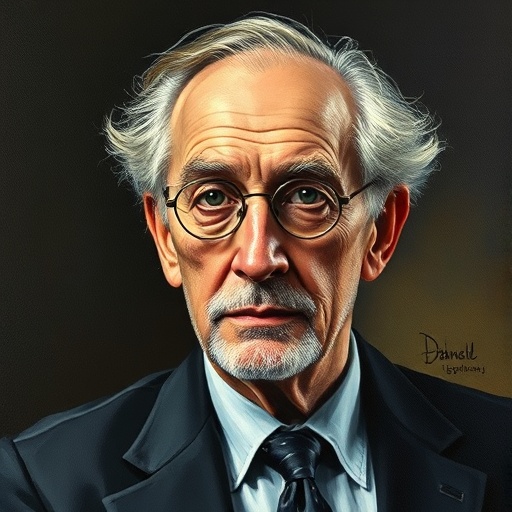
Francis Crick — "The most important thing for me is to understand."
The most important thing for me is to understand.
The most important thing for me is to understand.
Click any product to generate a realistic preview. Up to 3 at a time.
* Initial load can take up to 90 seconds — revising the preview in another color is nearly instant.
"The Christian believer is like a tenant who is about to sign a lease on a flat when someone tells him that the owner of the flat does not exist."
"The genetic material must be able to replicate itself."
"It is always a good thing to be slightly eccentric."
"A theory that fits all the facts is bound to be wrong, as some of the facts will be wrong."
"The belief that we have immortal souls is a superstition."
Found in 1 providers: grok
1 source checked
Crick is saying that grasping how something actually works matters more to him than fame, recognition, money, or even being the one who solves it. The drive is comprehension itself—piecing together a real explanation of reality. Curiosity is treated as the engine of a worthwhile life, and any reward beyond genuine understanding is secondary or even beside the point of doing serious intellectual work.
Crick spent his career chasing two of biology's hardest puzzles: the molecular basis of heredity, cracked with Watson in 1953 when they modeled DNA's double helix, and later the neural basis of consciousness at the Salk Institute. He famously left physics for biology purely because the questions fascinated him, and switched again from genetics to the brain in his sixties. Understanding, not credentialing or staying in one lane, drove every pivot.
Crick worked through a mid-twentieth-century revolution when physicists, chemists, and biologists were converging on life's machinery. Postwar Cambridge, X-ray crystallography, and Schrödinger's What Is Life? pulled minds toward molecular biology, while the Cold War poured funding into basic science. By his later years, the genetic code was solved and consciousness was the next frontier. It was an era that rewarded thinkers willing to cross disciplines purely to understand nature.
AI-generated insights based on extensive research and information for context. Factual errors? Email [email protected].
Your cart is empty