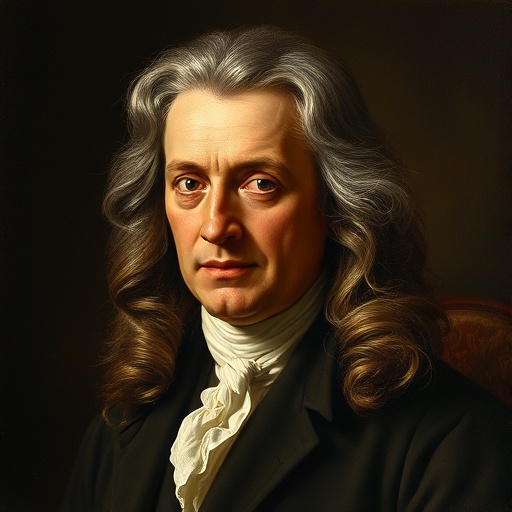
Isaac Newton — "Nothing can be divided into fewer parts than it hath."
Nothing can be divided into fewer parts than it hath.
Nothing can be divided into fewer parts than it hath.
Click any product to generate a realistic preview. Up to 3 at a time.
* Initial load can take up to 90 seconds — revising the preview in another color is nearly instant.
"The power of gravity is of such a nature as to penetrate to the very centres of the sun and planets, without suffering the least diminution of its force."
"A man may imagine things that are false, but he can only understand things that are true, for if the things be false, the apprehension of them is not understanding."
"The changing of bodies into light, and light into bodies, is very conformable to the course of Nature."
"I consider my experiments as a kind of play."
"In the absence of any other proof, the thumb alone would convince me of God's existence."
Found in 1 providers: grok
1 source checked
Everything has a minimum number of constituent parts—you cannot subdivide something below its fundamental units. Division has a floor. Once something is at its irreducible state, further splitting produces something categorically different, not fewer pieces of the same thing. In modern terms: atoms, quarks, and fundamental particles embody this idea. Nature is not infinitely divisible; there is always a smallest meaningful unit beyond which the original thing ceases to exist.
Newton was a committed corpuscularian, believing matter consisted of fundamental particles that could not be infinitely subdivided. His Opticks argued light itself was made of discrete corpuscles. His mathematics explored infinitesimals, yet his physics required irreducible physical foundations. Without a smallest part, forces and motion lose coherent grounding. This principle runs through his entire mechanical worldview: the universe is built from indivisible fundamentals obeying precise laws, not from infinitely continuous, shapeless substance.
Newton worked when ancient Greek atomism—Democritus and Epicurus—was being revived and reconciled with Christian natural philosophy. Descartes' dominant rival framework posited infinitely divisible, continuous matter organized by vortices. Newton and contemporaries like Boyle championed corpuscularianism as the mechanistic alternative. Whether matter was discrete or continuous was among natural philosophy's deepest open questions, carrying theological weight: an infinitely divisible world challenged ideas of divine creation from bounded, purposeful substance.
AI-generated insights based on extensive research and information for context. Factual errors? Email [email protected].
Your cart is empty