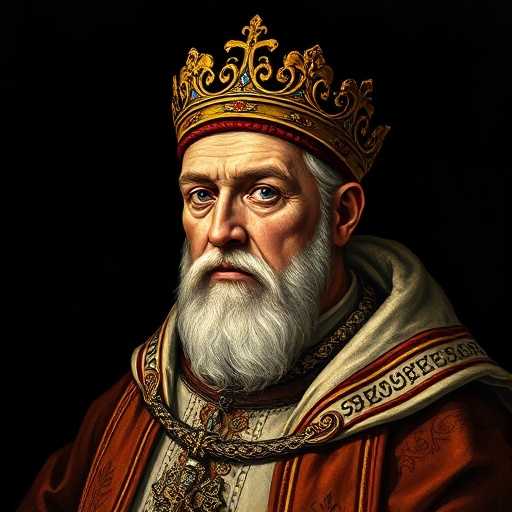
Pope Urban II — "O most valiant soldiers and descendants of invincible ancestors, do not degenera…"
O most valiant soldiers and descendants of invincible ancestors, do not degenerate, but recall the valor of your forefathers.
O most valiant soldiers and descendants of invincible ancestors, do not degenerate, but recall the valor of your forefathers.
Click any product to generate a realistic preview. Up to 3 at a time.
* Initial load can take up to 90 seconds — revising the preview in another color is nearly instant.
"When you have decided to go, you must publicly make your vow and dedicate yourselves to God."
"Let those who have formerly been mercenaries at low wages, now gain eternal rewards. Let those who have been striving to the detriment both of body and soul, now labor for a two-fold reward."
"All who are going to go into battle should wear the sign of the cross on their garments."
"Oh, what a disgrace if such a despised and base race, which worships demons, should conquer a people which has the faith of omnipotent God and has been made glorious with the name of Christ!"
"We desire that you, with all the faithful, should hasten to the aid of the Christians, and strive to deliver them from the hands of the pagans."
Pope (1088-1099) whose Council of Clermont speech (November 1095) launched the First Crusade — the founding event of nine centuries of Christian-Muslim military conflict. Closely associated with Pope Gregory VII (his predecessor on papal-imperial reform). For an intellectual contrast, see Saladin, Kurdish-Muslim Sultan of Egypt and Syria (1138-1193) — Saladin recaptured Jerusalem in 1187, undoing the First Crusade Urban II launched 92 years earlier. Saladin's chivalrous treatment of Christian prisoners became the canonical Muslim counter-image to Crusader brutality. The cleanest before/after pairing of the Crusades' moral arc.
Found in 1 providers: grok
1 source checked
Do not fall short of your ancestry—be as brave and capable as those who came before you. This is a call to live up to inherited greatness, to match the courage and strength of prior generations rather than growing weak or complacent. It challenges people to see themselves as heirs to a legacy that demands active, courageous participation rather than passive inheritance.
Urban II delivered this precise exhortation at the Council of Clermont in 1095, launching the First Crusade. As pope, he wielded spiritual and political authority to mobilize Christian Europe. His genius lay in framing military conquest as sacred duty and ancestral obligation, merging Christian piety with warrior culture to recruit knights who prized lineage and honor above almost everything.
Medieval Europe was deeply organized around bloodlines, feudal obligation, and inherited honor. Knights defined themselves through their ancestors' deeds. Simultaneously, the Seljuk Turks had seized Jerusalem and threatened Byzantium. Urban II exploited both realities—ancestral pride and religious crisis—to forge an unprecedented military coalition, making appeals to lineage politically and emotionally irresistible to the feudal warrior class.
AI-generated insights based on extensive research and information for context. Factual errors? Email [email protected].
Your cart is empty