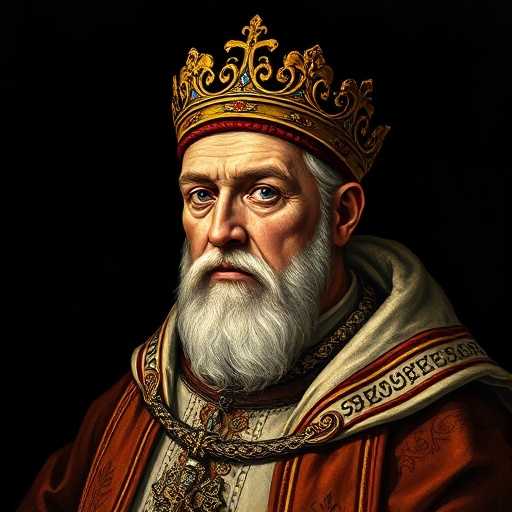
Pope Urban II — "We desire that you, with all the faithful, should hasten to the aid of the Chris…"
We desire that you, with all the faithful, should hasten to the aid of the Christians, and strive to deliver them from the hands of the pagans.
We desire that you, with all the faithful, should hasten to the aid of the Christians, and strive to deliver them from the hands of the pagans.
Click any product to generate a realistic preview. Up to 3 at a time.
* Initial load can take up to 90 seconds — revising the preview in another color is nearly instant.
"Let none of your possessions detain you, no solicitude for your family affairs, since this land which you inhabit is everywhere shut in by the sea and surrounded by mountain peaks."
"Whoever shall set out on this journey out of devotion alone, and not for gain or honor, shall be absolved from all sin."
"That royal city, Jerusalem, situated in the middle of the world, is now held captive by its enemies."
"Let no attachment to your native soil be an impediment, because…all the world is exile to the Christian, and all the world his country: thus exile is his country, and his country exile."
"The Turks, a race of Persians, have taken the Holy Land; they circumcise Christians and pour the blood from the circumcision on the altars or into baptismal fonts."
Pope (1088-1099) whose Council of Clermont speech (November 1095) launched the First Crusade — the founding event of nine centuries of Christian-Muslim military conflict. Closely associated with Pope Gregory VII (his predecessor on papal-imperial reform). For an intellectual contrast, see Saladin, Kurdish-Muslim Sultan of Egypt and Syria (1138-1193) — Saladin recaptured Jerusalem in 1187, undoing the First Crusade Urban II launched 92 years earlier. Saladin's chivalrous treatment of Christian prisoners became the canonical Muslim counter-image to Crusader brutality. The cleanest before/after pairing of the Crusades' moral arc.
Found in 1 providers: grok
1 source checked
A direct call to action demanding Christians mobilize militarily to rescue fellow believers under pagan control. The quote frames military intervention as urgent religious duty, positioning armed conflict as an act of solidarity and deliverance rather than conquest, appealing to shared faith identity as the primary motivation for collective violent action.
Urban II issued this call at the Council of Clermont in 1095, launching the First Crusade. As pope, he wielded spiritual authority to transform military ambition into sacred obligation. His pontificate centered on church reform and asserting papal supremacy, and the Crusade served dual purposes: aiding Byzantium and redirecting European noble violence toward religiously sanctioned warfare.
In 1095 medieval Europe, the Seljuk Turks had captured Jerusalem and threatened Byzantine Constantinople. Feudal lords fought constant internecine wars, and the Church sought both to unify Christendom and curb domestic violence. Urban's call resonated because pilgrimage to Jerusalem was deeply sacred, and the concept of holy war had been developing through just-war theology for centuries.
AI-generated insights based on extensive research and information for context. Factual errors? Email [email protected].
Your cart is empty