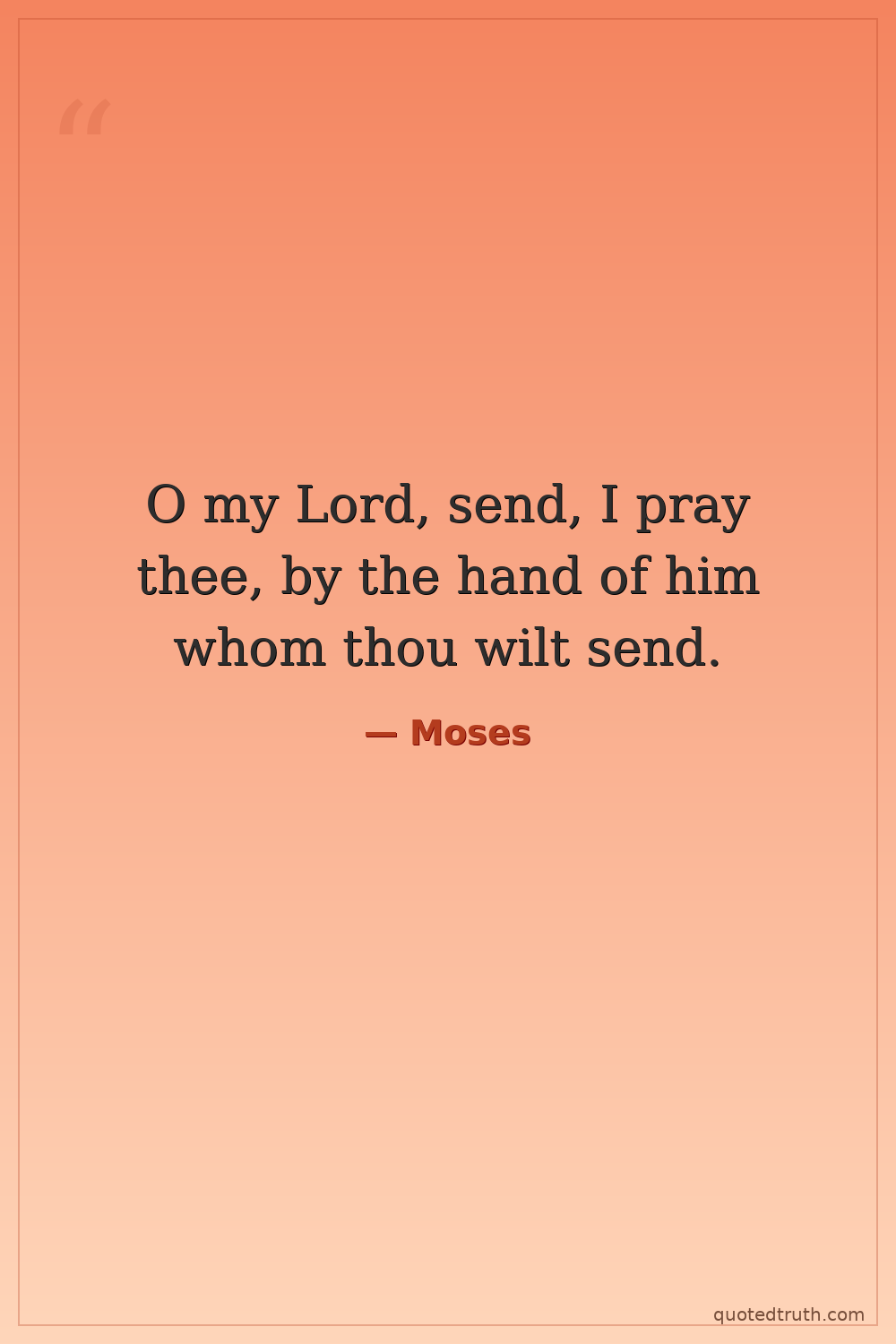
Moses — "O my Lord, send, I pray thee, by the hand of him whom thou wilt send."
O my Lord, send, I pray thee, by the hand of him whom thou wilt send.
O my Lord, send, I pray thee, by the hand of him whom thou wilt send.
Click any product to generate a realistic preview. Up to 3 at a time.
* Initial load can take up to 90 seconds — revising the preview in another color is nearly instant.
"What is that in thine hand? And he said, A rod."
"You shall not covet your neighbor’s house. You shall not covet your neighbor’s wife, or his male or female servant, his ox or donkey, or anything that belongs to your neighbor."
"You shall not plant your field with two kinds of seed."
"You shall not give false testimony against your neighbor."
"Man does not live on bread alone but on every word that comes from the mouth of the LORD."
Exodus 4:13, spoken to God after being tasked with leading Israel
Date: c. 13th century BCE (biblical account)
GeneralFound in 1 providers: grok
1 source checked
Moses is essentially saying, 'Please pick someone else.' He's reluctant to take on a massive responsibility and is asking God to choose a different person for the job. It captures that moment when you're handed an overwhelming assignment and instinctively try to pass it off to someone more qualified, more eloquent, or simply more willing to step into the spotlight.
Moses spoke these words at the burning bush when God commissioned him to confront Pharaoh and lead Israel out of Egypt. He cited his slow speech and stuttering as disqualifications, revealing deep self-doubt despite later becoming Judaism's greatest prophet and lawgiver. This reluctance defined his call narrative and foreshadowed his humility, which the Torah praises as unmatched among all people on earth.
Around the 13th century BCE, Hebrew slaves labored under Egyptian bondage while Pharaoh's regime held absolute divine-kingship authority. Challenging Pharaoh meant confronting a living god-king backed by military power and an established priesthood. In that era, prophetic callings were rare and dangerous, and leaders were expected to possess commanding oratory. Moses's hesitation reflects the genuine peril and cultural weight of speaking against Egypt's throne.
AI-generated insights based on extensive research and information for context. Factual errors? Email [email protected].
Your cart is empty