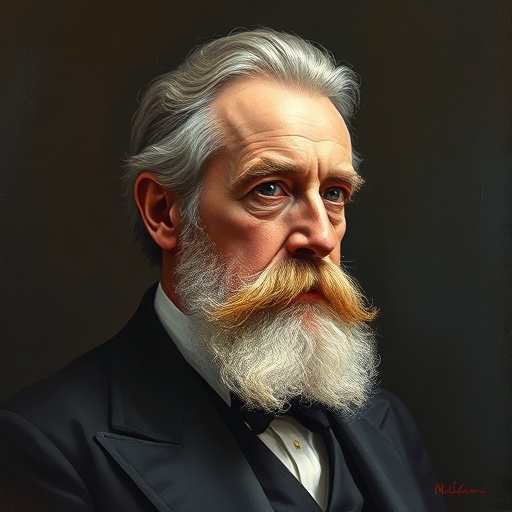
Alexander Graham Bell — "Observe, Remember, Compare."
Observe, Remember, Compare.
Observe, Remember, Compare.
Click any product to generate a realistic preview. Up to 3 at a time.
* Initial load can take up to 90 seconds — revising the preview in another color is nearly instant.
"Don't keep forever on the public road, going only where others have gone. Leave the beaten track occasionally and dive into the woods. Every time you do so you will be certain to find something that y…"
"You cannot force ideas. Successful ideas are the result of slow growth. Ideas do not reach perfection in a day, no matter how much study is put upon them. It is perseverance in the pursuit of studies …"
"The most important thing is to keep on trying, to never give up."
"I did not invent the telephone, the telephone invented me."
"The world is full of people who are waiting for someone to come along and inspire them to be what they always wanted to be."
Found in 1 providers: gemini
1 source checked
Effective understanding comes from three disciplined mental acts: watching the world carefully, retaining what you witness, and measuring new observations against past ones. Together these build genuine knowledge. It is a compact formula for scientific thinking — not passive experience, but active, structured engagement with reality that transforms raw perception into insight and eventually innovation.
Bell was a meticulous experimentalist who spent years observing acoustic phenomena before inventing the telephone in 1876. His work on speech for the deaf — shaped by his mother's hearing loss and his wife Mabel's deafness — required exactly this triad: observing how sound behaved, remembering results across hundreds of failed experiments, and comparing outcomes to refine the design that finally transmitted a human voice electrically.
Bell worked during the Second Industrial Revolution of the 1870s–1880s, when empirical method was displacing pure theory as the engine of invention. Edison, Tesla, and Bell competed in rapid iteration. Scientific observation had been formalized through Darwin, Faraday, and Pasteur. The era rewarded those who systematically recorded and cross-referenced findings — making Bell's three-word formula both a personal creed and a zeitgeist distillation of Victorian-era experimental science.
AI-generated insights based on extensive research and information for context. Factual errors? Email [email protected].
Your cart is empty