What it means
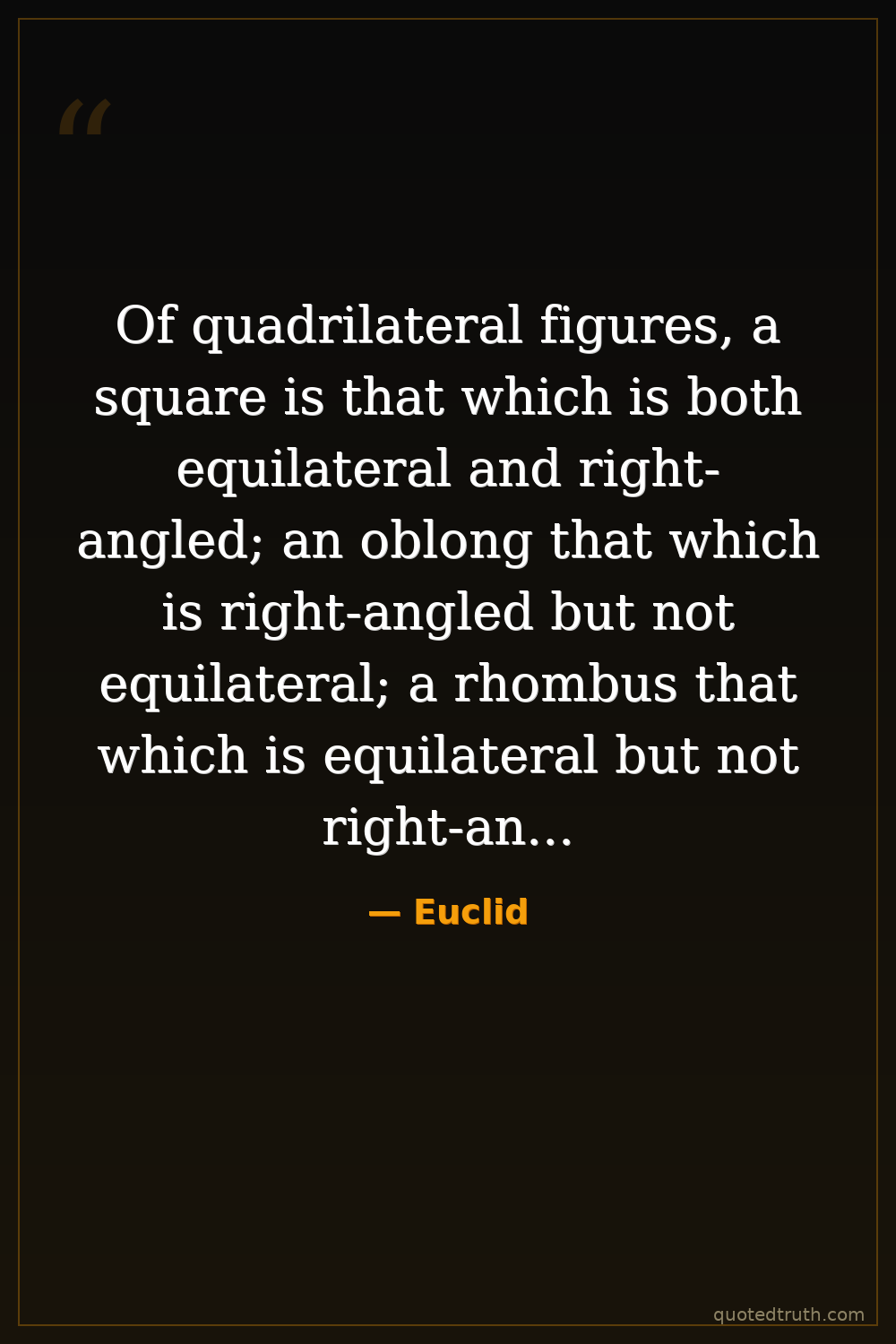
A square has four equal sides and four right angles. An oblong (rectangle) has right angles but unequal sides. A rhombus has equal sides but no right angles. A rhomboid has equal opposite sides and angles but neither equal sides nor right angles. Everything else is a trapezium. This is pure definitional precision — establishing shared vocabulary so geometry can reason without ambiguity.
Relevance to Euclid
Euclid built mathematics on explicit definitions before proving anything, a method central to his Elements. This passage is literally from Book I of Elements, where he lays foundational definitions. His genius was recognizing that geometry collapses into confusion without agreed-upon terms — so he defined everything first, reflecting his belief that rigorous foundations precede all reasoning.
The era
Around 300 BCE in Alexandria, Greek scholars were systematizing knowledge across philosophy, medicine, and mathematics. No standardized geometric vocabulary existed before Euclid. Different Greek city-states used inconsistent terms. Euclid wrote under Ptolemy I, whose Library of Alexandria sought to gather and codify all human knowledge — making Euclid's definitional rigor perfectly aligned with that era's intellectual mission of universal systematization.
AI-generated insights based on extensive research and information for context. Factual errors? Email [email protected].