What it means
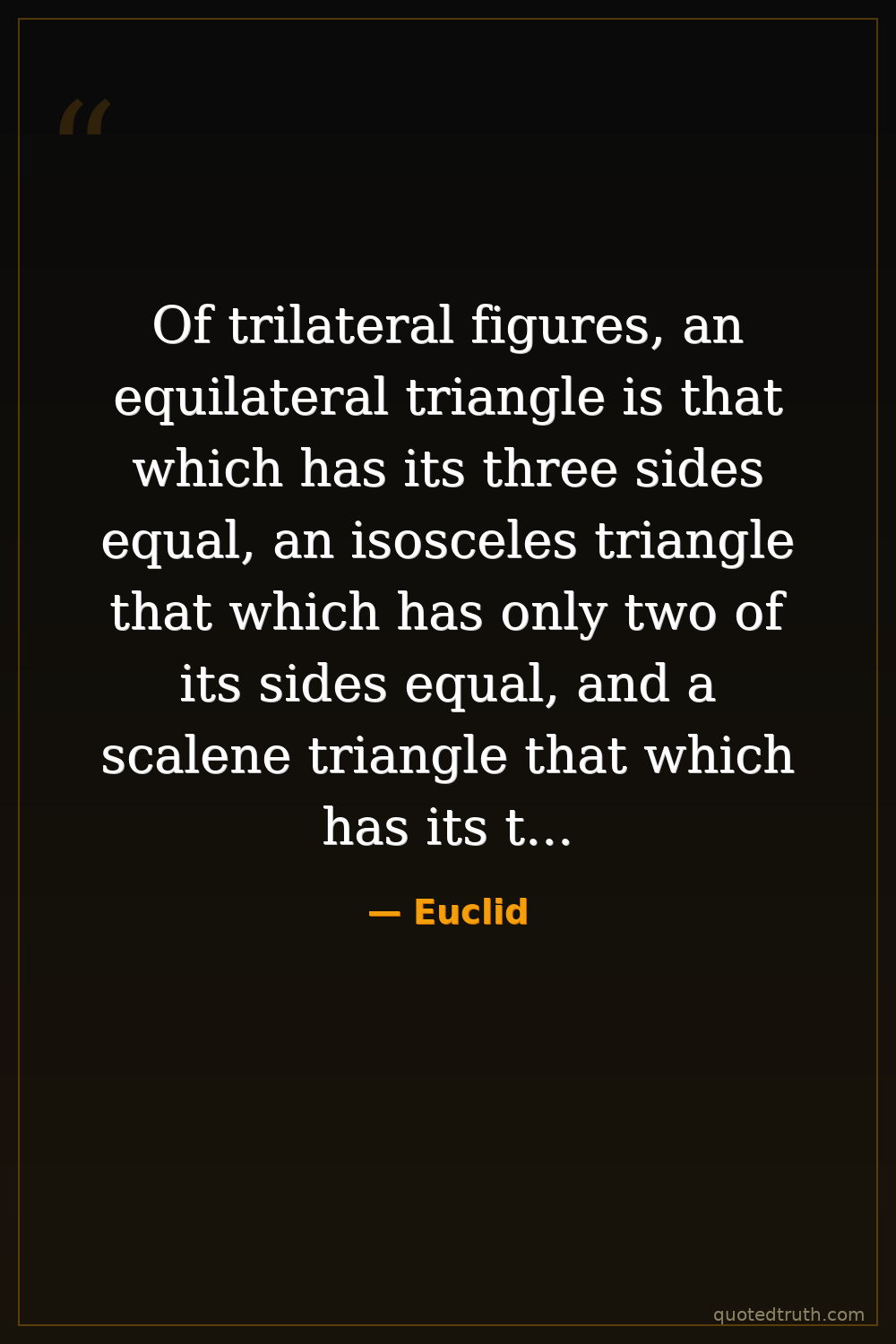
This defines three types of triangles purely by the equality of their sides: equilateral triangles have all three sides equal, isosceles triangles have exactly two equal sides, and scalene triangles have no equal sides. It is a foundational classification system—precise, exhaustive, and mutually exclusive—establishing shared vocabulary for geometry so mathematicians communicate without ambiguity. These definitions remain standard in mathematics classrooms worldwide today.
Relevance to Euclid
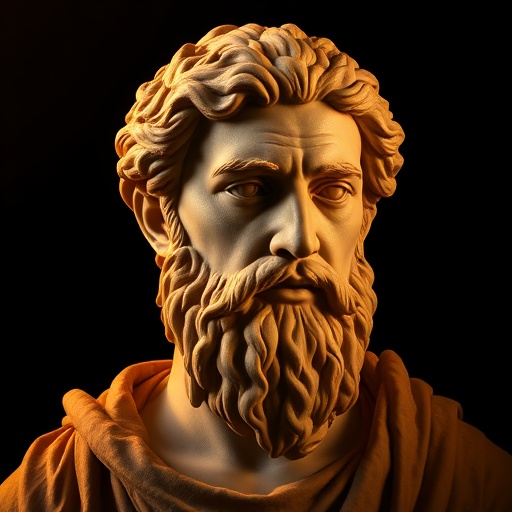
Euclid's Elements opens with dense definitions before any theorems—a deliberate architectural choice. As the father of axiomatic geometry, he believed mathematics must begin with unambiguous terms. This quote captures his core method: classify everything precisely before proving anything. Working in Alexandria around 300 BCE, Euclid built a deductive system so airtight it served as the global standard for mathematical reasoning for over two thousand years.
The era
Around 300 BCE, Greek mathematics was transforming from practical measurement—as practiced in Egypt and Babylon—into abstract, proof-based reasoning. Euclid worked in Alexandria under Ptolemy I at the newly founded Library, which aimed to collect all human knowledge. Rigorous definition-making was revolutionary here: thinkers were shifting from asking how to build to asking what we know and why. Naming triangle types precisely was part of this sweeping project of universal intellectual systematization.
AI-generated insights based on extensive research and information for context. Factual errors? Email [email protected].