What it means
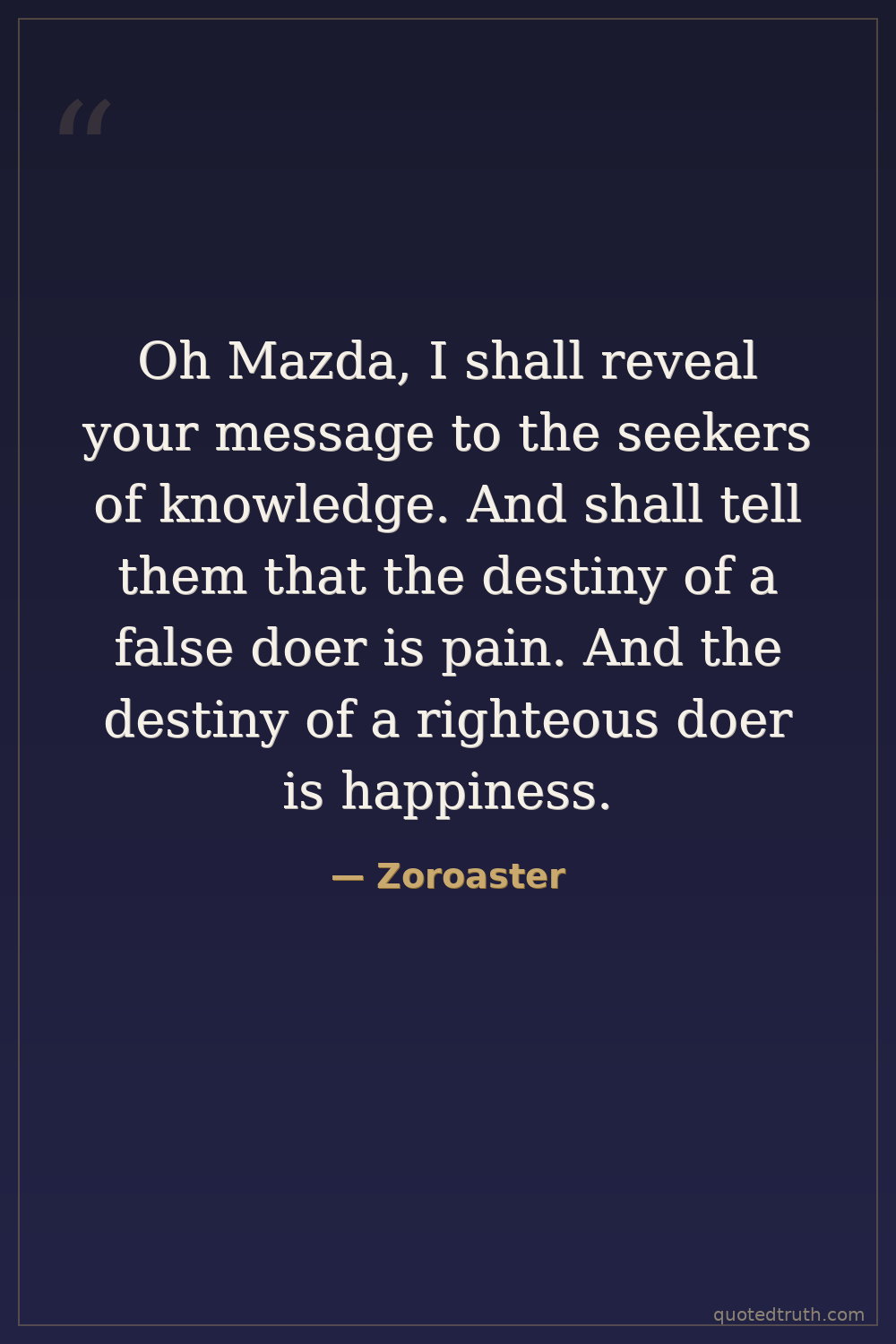
The speaker promises to share divine teachings with people who genuinely want to learn. The core message is moral: people who act deceitfully or harmfully will eventually face suffering, while those who live honestly and do good will find lasting happiness. It frames ethics as a built-in law of reality, not arbitrary rules, tying your choices directly to the life you end up experiencing.
Relevance to Zoroaster
Zoroaster cast himself as a prophet revealing Ahura Mazda's message, and this line mirrors the Gathas, the hymns he personally composed. His entire mission centered on the cosmic clash between asha (truth) and druj (the lie), and on free moral choice. The promise to teach 'seekers of knowledge' fits his role as reformer-priest preaching directly to receptive listeners rather than relying on inherited ritual authority.
The era
Zoroaster likely taught in Bronze Age eastern Iran, roughly the late second millennium BCE, amid tribal polytheism, animal sacrifice, and warrior raids. Morality was largely tied to clan loyalty and ritual correctness, not personal conscience. By proclaiming one supreme wise god and a universal moral reckoning where each individual's deeds determined their fate, he introduced ideas that later shaped Jewish, Christian, and Islamic concepts of heaven, hell, and judgment.
AI-generated insights based on extensive research and information for context. Factual errors? Email [email protected].