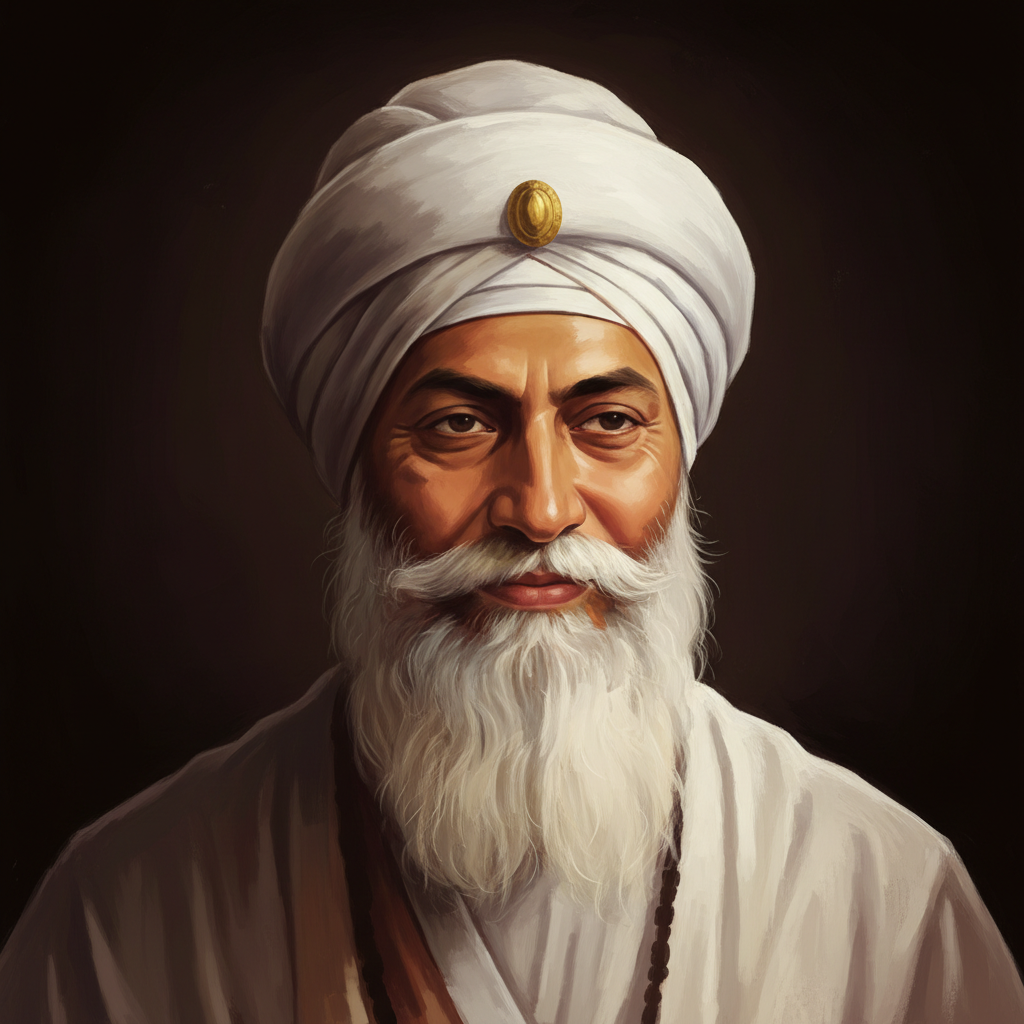
Guru Nanak — "One cannot comprehend Him through reason, even if one reasoned for ages."
One cannot comprehend Him through reason, even if one reasoned for ages.
One cannot comprehend Him through reason, even if one reasoned for ages.
Click any product to generate a realistic preview. Up to 3 at a time.
* Initial load can take up to 90 seconds — revising the preview in another color is nearly instant.
"The one who serves others, serves God."
"A true yogi does not wander around, but fixes his mind on God within."
"The greatest gift is to share. Especially if it's your last piece of samosa."
"The highest religion is to rise to universal brotherhood; aye, to consider all creatures your equals."
"He alone is a Brahmin who knows God."
Founder of Sikhism and the first of the Ten Sikh Gurus, whose teachings of one universal God and rejection of caste shaped Punjab. Closely associated with Kabir (mystical poet whose verses appear in the Sikh Guru Granth Sahib). For an intellectual contrast, see Brahmanical orthodoxy, the Hindu caste-and-ritual establishment of his era — Sikhism was founded as a deliberate alternative to both Hindu ritual hierarchy and Islamic exclusivism — Nanak's universalism was a structural rejection of caste and priestly mediation.
Found in 1 providers: grok
1 source checked
Pure logic and intellectual analysis cannot fully grasp the divine. No matter how long or how hard you think, reason alone hits a ceiling when trying to understand ultimate reality or God. The mind is a useful tool, but it is not the right instrument for this particular job. Genuine understanding of the sacred comes through direct experience, devotion, humility, and inner stillness rather than endless argument, debate, or philosophical calculation.
Guru Nanak founded Sikhism by rejecting empty ritualism and scholarly hair-splitting common in both Hindu and Muslim establishments of his day. He taught that God is realized through naam simran, honest living, and selfless service, not memorized scripture or theological cleverness. As a poet-mystic who composed the Japji Sahib, he consistently warned that the divine is beyond intellect and is touched only through grace, devotion, and a quiet, surrendered heart.
In early-modern north India around 1500, Guru Nanak lived under the Lodi Sultanate and the early Mughal invasions, a period of intense religious friction between orthodox Hindu Brahmins and Islamic clerics. Both sides emphasized ritual purity, caste, scriptural debate, and elaborate doctrine. Nanak traveled widely on his udasis, challenging this performative religiosity and offering a direct, experiential path to one universal God accessible to everyone regardless of caste, gender, or creed.
AI-generated insights based on extensive research and information for context. Factual errors? Email [email protected].
Your cart is empty