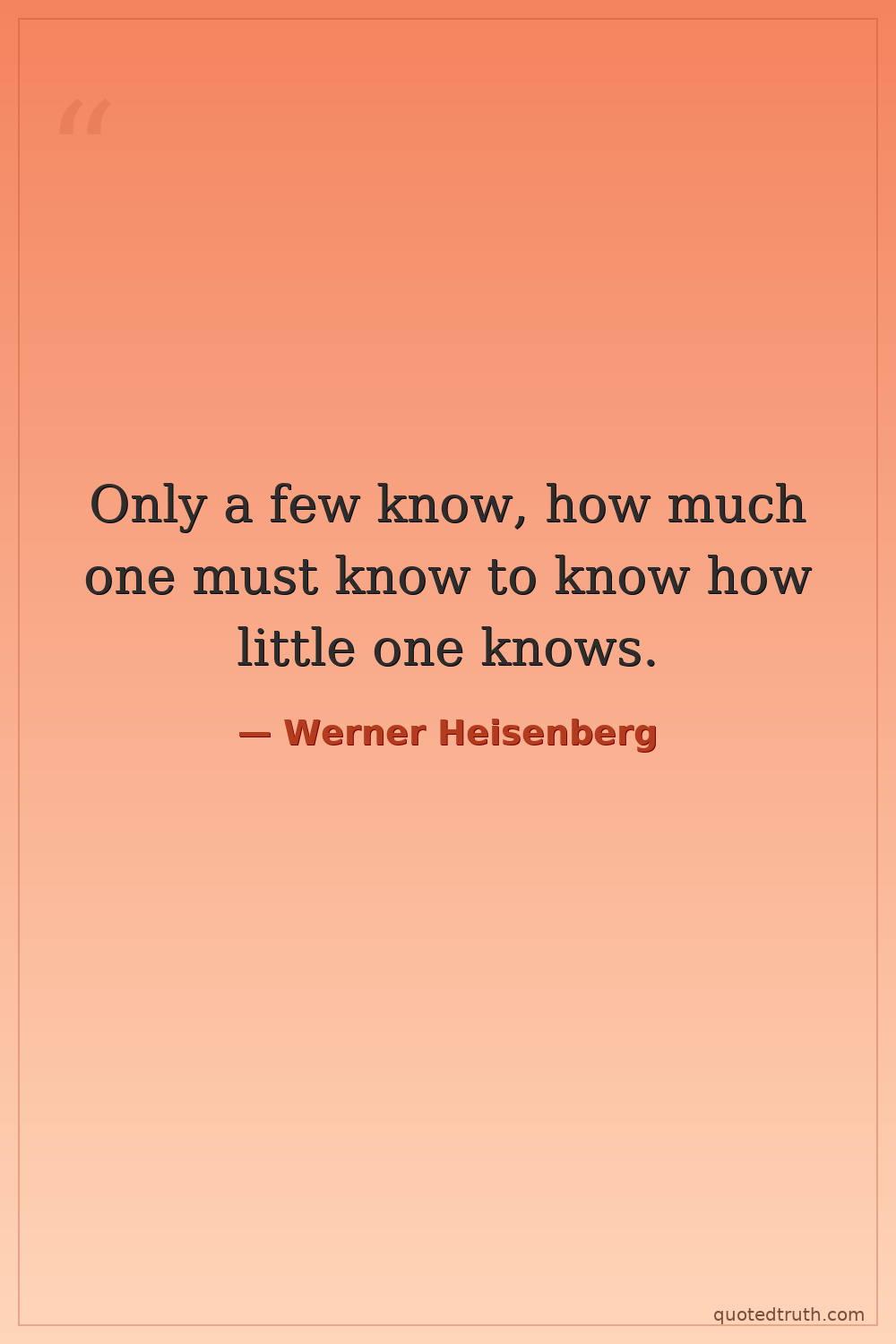
Werner Heisenberg — "Only a few know, how much one must know to know how little one knows."
Only a few know, how much one must know to know how little one knows.
Only a few know, how much one must know to know how little one knows.
Click any product to generate a realistic preview. Up to 3 at a time.
* Initial load can take up to 90 seconds — revising the preview in another color is nearly instant.
"The decision for a definite result is taken only when the measurement is made."
"The more precise the measurement of position, the more imprecise the measurement of momentum, and vice versa."
"An expert is someone who knows some of the worst mistakes that can be made in his subject and how to avoid them."
"Quantum theory does not really describe the behavior of 'things'; it describes the behavior of 'what we can know' about things."
"Can nature possibly be so absurd as it seemed to us in these atomic experiments?"
Found in 1 providers: gemini
1 source checked
True understanding of your own ignorance takes deep expertise. The more you learn about a subject, the more you recognize how vast the unknown is and how much ground remains uncovered. Only people who have pushed to the edge of a field grasp how limited even expert knowledge really is. Casual learners often feel more certain than specialists because they haven't seen the complexity lurking underneath. Humility grows with mastery, not away from it.
Heisenberg built his career on a literal mathematical limit to knowledge: the uncertainty principle, which proved you cannot simultaneously pin down a particle's position and momentum. He spent decades at the frontier of quantum mechanics, watching classical certainties dissolve into probability. As a Nobel laureate who wrestled with the philosophical fallout of his own equations, he knew firsthand that the deeper physicists probed reality, the more the solid ground of nineteenth-century science gave way beneath them.
Heisenberg worked during the 1920s-1970s, when physics was overthrowing two centuries of Newtonian confidence. Relativity, quantum theory, and Godel's incompleteness theorems all revealed hard limits to what science and logic could pin down. Meanwhile two world wars shattered faith in Enlightenment progress, and Heisenberg himself navigated the moral wreckage of Nazi Germany's atomic program. The era forced thinkers to accept that certainty, whether scientific, political, or moral, was far more fragile than the previous generation had assumed.
AI-generated insights based on extensive research and information for context. Factual errors? Email [email protected].
Your cart is empty