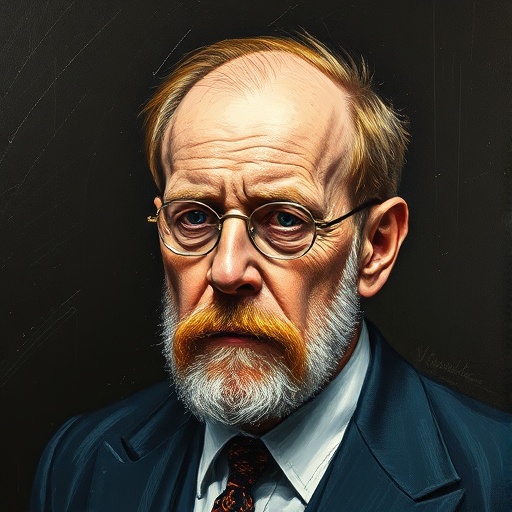
Werner Heisenberg — "The more precise the measurement of position, the more imprecise the measurement…"
The more precise the measurement of position, the more imprecise the measurement of momentum, and vice versa.
The more precise the measurement of position, the more imprecise the measurement of momentum, and vice versa.
Click any product to generate a realistic preview. Up to 3 at a time.
* Initial load can take up to 90 seconds — revising the preview in another color is nearly instant.
"The problems of atomic physics are not problems of technology, but problems of philosophy."
"The physical world is not real in the sense that it exists independently of our observing it."
"The positivists have a simple solution: the world must be divided into that which we can say clearly and the rest, which we had better pass over in silence. But can anyone conceive of a more pointless…"
"The more I think about the physical aspects of the electron, the more it becomes a puzzle."
"The idea of an objective real world whose smallest parts exist objectively in the same sense as stones or trees exist, independently of whether or not we observe them... is impossible."
Found in 2 providers: grok,deepseek
2 sources checked
You cannot know both where a particle is and how fast it's moving with perfect accuracy at the same time. Pin down its location precisely, and its speed becomes fuzzy; measure its speed exactly, and its position blurs. This isn't a flaw in our tools but a fundamental limit built into nature itself. At the smallest scales, reality resists being fully pinned down, forcing us to accept trade-offs in what we can know.
This is Heisenberg's signature contribution to physics, formulated in 1927 when he was just 25. As a founder of quantum mechanics, he shattered classical determinism and earned the 1932 Nobel Prize for this insight. The principle reflected his philosophical bent, shaped by studying under Bohr and Born, and his willingness to abandon intuitive certainty for mathematical truth, even when it unsettled Einstein and other giants of his era.
The 1920s saw physics in upheaval as experiments with atoms and electrons defied Newtonian rules. Europe's intellectual centers—Göttingen, Copenhagen, Munich—buzzed with young theorists rebuilding reality's foundations. This coincided with broader modernist shifts: Freud questioned conscious control, Einstein had relativized space-time, and artists fractured perspective. Heisenberg's principle fit a Weimar-era zeitgeist that embraced uncertainty, later casting a shadow over his controversial WWII role leading Nazi Germany's nuclear program.
AI-generated insights based on extensive research and information for context. Factual errors? Email [email protected].
Your cart is empty